Showing posts with label White House. Show all posts

Wednesday, January 15, 2014

One Proposed Measure of Obamacare Success: Drop-Outs from the Bronze and Silver Plans


Quick: if you had to chose a limited number of measures to gauge success of the Affordable Care Act, what would you choose?  Would it be the number of persons who have enrolled in healthcare.gov? The number of persons who have paid for their insurance and have coverage?  The number of young people with coverage?  The degree of spin used by the White House?

Naturally, the quizzical Disease Management Care Blog proposes a different metric:

The percent of persons with either 1) "silver" or 2) "bronze" plans who have gone two or more months without paying their insurance premium.

Why, you ask?

1) The silver and bronze plans, because their monthly premium is lower, will attract a disproportionate number of persons who were previously unable to afford health insurance and are now newly insured;

2) According to this just published JAMA article, even if their monthly premiums are fully or partially subsidized, these lower-cost insurance plans cover only up to 60% to 70% of medical expenses. That means cost sharing that can be excess of $6000 and $12,000 for individuals and families, respectively.

As these newly insured persons begin to access health care, high out-of-pocket expenses can lead to two scenarios:

1) Those with subsidized insurance will resent paying anything for a plan that stretches the very definition of "health insurance," or

2) Those with partially subsidized or unsubsidized insurance, because of their mounting bills, won't be able to pay the premium

Either drop-out scenario is very possible.  The DMCB isn't aware of any data that describes the normal drop-out rate in low-premium/high out of pocket health insurance plans, but that number exists somewhere.  If Obamacare has a higher than expected rate of of drop-outs, that could spell trouble.  If the drop-out rate is low, things are going well.

CODA: The image above is an example of an enterprise data dashboard, which is intended to help companies track real time success in achieving specified targets.  It's arguably a best management practice and it shouldn't be too much to expect the White House to post an ACA "healthcare" dashboard on their web site.  Why not?

Image from Wikipedia

Tuesday, May 28, 2013

Does ANYONE Really Know Projected Health Care Costs? Nope!

You sure about that?
According to the White House, the Affordable Care Act (ACA) is obviously responsible for the significant decrease in health care cost inflation over the last three years.
The respected health economist Victor Fuchs, writing in the New England Journal, disagrees.  He points out:

1) there is a strong relationship between growth in the U.S. gross domestic product (GDP) and growth in health care spending: for the last 60 years, when one goes up, the other follows suit.  While the prevalence of illness drives the consumption of health care, it turns out that the prevalence of illness plus a rising income is a stronger driver of health care consumption*.

It's far more likely that the lackluster economy has been responsible for the low rate of inflation.

2) Two to three years is not enough time to guage the impact of any single intervention on health care spending. In his NEJM article, Dr. Fuchs presents a graph showing the relationship between a two year period of spending and what follows over the next twenty years.  It turns out it's a very poor predictor.

So, even if the ACA could have an impact, it's far too early to tell.

In the meantime, skeptics like Bob Laszewski, are pointing to richer mandated insurance benefits and are confidently predicting that health care costs are destined to increase.  Former CBO Director Douglas Holtz-Eakin worries young healthy adults won't sign up, which could further fuel health insurance premium increases.

Who to believe?  A partisan White House?  Skeptics who want a return to market-based insurance?  The DMCB's solution is to believe Dr. Fuchs and confidently state it doesn't know which way things are going to go.

*The only exception to the association between GDP and health care costs was during the mid-1990's when managed care had its stranglehold on the delivery system

Image from Wikipedia

Monday, February 11, 2013

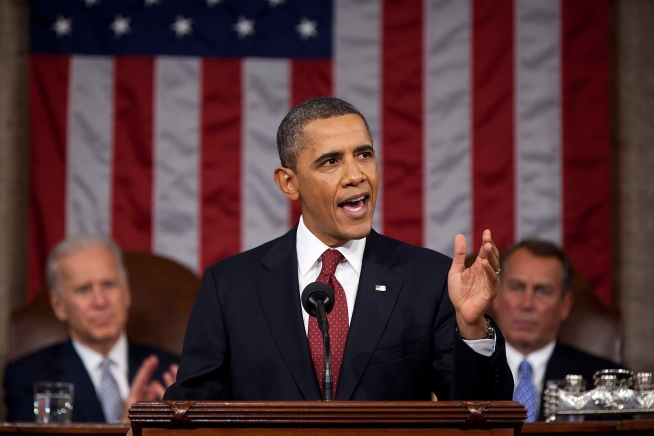
Health Policy Speech Options on the Eve of the State of the Union

It's the eve of Mr. Obama's State of the Union address (or, as the beltway cognoscenti apparently refer to it, "SOTU").

What better way for the Disease Management Care Blog readers to mark this momentous occasion than by pretending that we're in the Oval Office advising the President on the best way forward?

Here are some your options in helping our Chief Executive dispatch the problematic sequester, sustainable growth rate, Medicare and health reform.  Who knows, maybe someone from the White House is paying attention.....

Realizing that the sequester is both a bad deal for Medicare and a trap for the Democratic party, you recommend:

1. compromising,
2. changing the subject back to "evil insurers,"
3. a series of heartland speeches with nodding fawning accountants sharing the stage that explains to the American people the federal budget sequester and why you signed the enabling legislation in the first place,
4. hiring a Kardashian lawyer because he'll know how to arrange a quickie divorce from the sequester deal.

To fix the SGR and prevent a physician flight from Medicare participation, you recommend:

1. compromising,
2. changing the subject to "oil companies,"
3. applying the vast anticipated 2016 savings from the "Medical Home" and ACOs to this year's budget shortfall; if necessary add another zero or two,
4. re-tasking the controversial military drone program to drop freshly minted $100 bills on doctors' offices.

You want mention Marilyn Tavenner, Acting Director for CMS, and ask that she confirmed by the Senate.  To make this happen, you advise the President to:

1. nominate her in the regular course of business and trust the Senate will do the right thing,
2. ask her to change the subject to the White House meme of "corporate jets,"
3. announce she will expand the care management program for FFS Medicare beneficiaries, ignoring, for the moment, that that is the largest insured population in the U.S. without that benefit,
4. fix the Chuck Hagel debacle by changing Ms. Taveneer's nomination to Secretary of Defense

 Knowing that the President risks having his second-term being stymied by a defiant opposition party, you suggest Mr. Obama neutralize them by:

1. reaching out with Lincoln-esque "malice toward none and charity for all."
2. characterizing Republicans as "hateful munchkins"
3. recycling the "previous administration" blame strategy by reminding listeners it was Mr. Bush who kicked off the electronic health record mess in a previous State of the Union address and that its yet-unfulfilled promise is not your fault either.
4. suggesting everyone get out of their closed partisan information loops by regularly reading the Disease Management Care Blog.

Since 2014 promises to be the watershed year for Obamacare, you remind the President to:

1. avoid the subject because everyone's projections are turning out to be wrong
2. decide now between the red pill and the blue pill
3.  announce that his White House advisors know more than any commercial health insurance executive about the underlying actuarial equivalence of an essential health benefit
4. in contrast to the 2010 SOTU, be respectful to the Supreme Court because they saved your Obamacare as*.