Showing posts with label Innovation. Show all posts

Thursday, March 17, 2016

Busting Through the Healthcare Performance Frontier

Breakthrough!
The costs of business performance - for example, customer delight, reputational excellence, high worker satisfaction, workplace safety, leadership diversity, environmental sustainability or reducing social disparities - are typically viewed through the lens of a zero-sum game. 

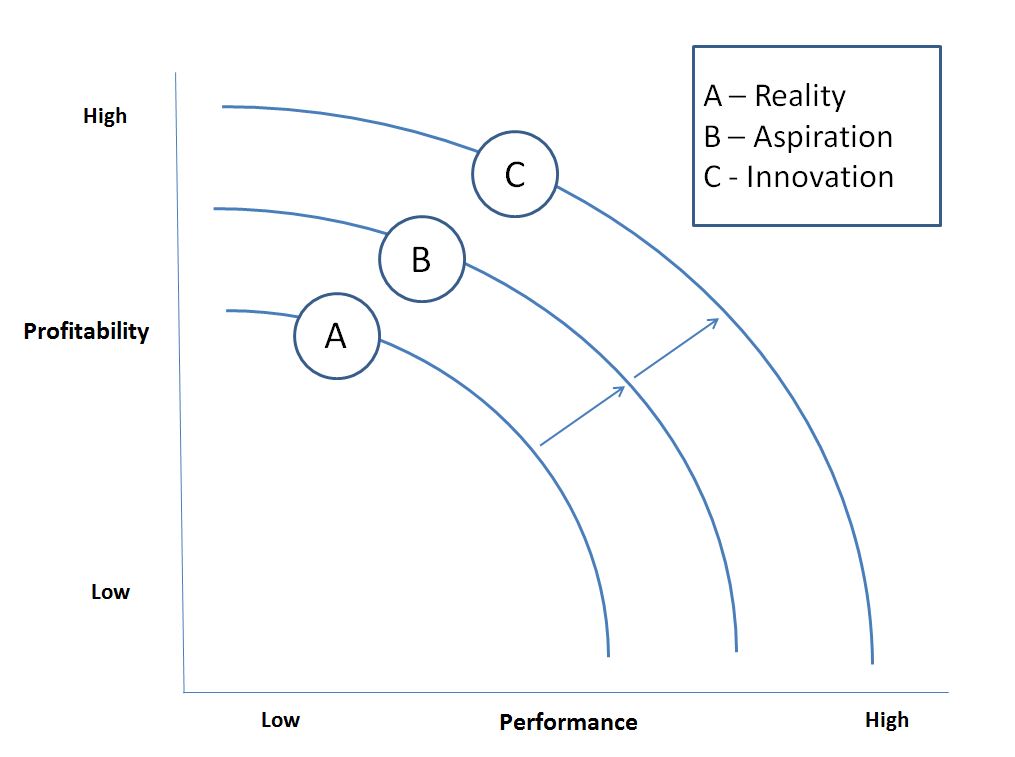
In this classic world view, achieving profitability means cutting performance, while pursuing high performance reduces profits. The relationship between the two variables can be displayed as a curve:


Population Health Blog readers can find out more about this here.

Most firms in the real world operate on the "A" curve.  Different firms under different circumstances make dozens, if not hundreds, of decisions on a day-to-day basis involving trade-offs that move them along the curve that extends along the profitability and performance continuum.

Examples of healthcare companies that moved up on the curve at the expense of performance include the Veterans Administration and Turing Pharmaceuticals.  At the other end of the curve, the understandable unwillingness of some hospitals to walk away from their community service obligations may have led them to bankruptcy.

The "B" curve represents the theoretical limit for greater profitability and performance using the current business model.  In other words, as companies maximize all opportunities and minimize all inefficiencies in their existing business models, they can move the curve up and to the right.  That is what all management, executives and boards can define and aspire to.  That "B" curve is known as the "performance frontier."

Examples of healthcare companies that moved toward the "B" curve? You can find more about them here.  If they're hospitals, they fill beds with short lengths of stay and high patient satisfaction.  If they're clinics, they maximize billing revenue and minimize waiting lists.  If they're an ACO, they manage risk by contracting for an actuarially optimum population while pursuing the Triple Aim.
  
The "C" curve beyond the established frontier is what becomes possible with transformational innovation, superb leadership or both. Examples outside of healthcare include Apple under Steve Jobs and Tesla under Elon Musk. Firms that create value by inspiring employees, new products and innovative processes not only benefit from even greater profitability, but offer enhanced performance

In "C" level healthcare settings, the top-line growth and decreasing costs would be accompanied by better measures of customer/patient well-being, community burden of disease, worker engagement, leadership diversity and improvements in social determinants of health.

While the Population Health Blog eagerly awaits reports of frontier-busting healthcare providers, it offers a few observations:

1. Healthcare organizations have generally not done a good job in defining and measuring their performance metrics.  They've also not made them part of the C-suite's DNA or placed them prominently on their governing boards' agendas. If they did, breakthroughs would become more likely.

2. The EHR's primary functions of billing and documentation will never get healthcare organizations to the C curve.  This is not part of a breakthrough strategy.

3. In contrast, big data, risk stratification, mHealth and machine intelligence have the economic/business potential to identify risk, channel the right care, circumvent high cost service options and rationalize decision-making, but could also increase performance through the engagement of consumers, increasing access to more care options, reducing disparities and minimizing provider busywork.  These are the ingredients for a breakthrough to C-curve level performance that is only just beginning.

4. By the way, another ingredient for high healthcare provider performance can be found here.

5. Last but not least, the leadership of many innovative health technology companies already intuit much of this.  They're looking for partners that are not just looking for "B" level performance, but want to bust through the performance frontier. 


Tuesday, July 29, 2014

"Necessity is the Mother of Innovation": Here's the Four That Need It

Actually, the Population Health Blog wishes it had coined that adage.

While a quick internet search indicates that the quote is on a host of business websites, the PHB only just discovered it on this post on disruptive health care innovation.

While there's a lot of management jargon, the author makes a good point about health reform's four necessities.  Any health technology provider, clinical enterprise, population health vendor, pharma company, health insurer, research outfit or government entity that can solve just one will have our collective gratitude. 

1) Millions of new Medicaid enrollees who are struggling with the twin burdens of poor health status and socioeconomic challenges.  If there is a clinical-technology platform that can provide care for this population, now is the time for it to step forward.

2) An influx of healthy millennials who, instead of having "needs" (that was their grandparents' problem) or "desires" (that was their parents' problem), have expectations that they believe can be significantly met with their handhelds.

3) Tens of millions of chronically ill persons who need to have a higher value medical home model scaled up, while we find even better industrial-based approaches to get them to self-manage.  At home.

4) High deductibles: if we can get money out of a checking account in Idaho while visiting Istanbul, there's got to be a way to minimize the disparate impact of high out of pocket expenses with increased transparency, value-based purchasing, tax sheltered accounts and other cloud-based financial tools.

Monday, April 22, 2013

Reducing Health Care Labor Costs In the United States: Lessons from Overseas

Now that the Affordable Care Act has increased access to health insurance, progressive-minded policymakers are now turning their attention to increasing access to care.  Costs are going up and there isn't enough to meet demand.

Unfortunately, as Disease Management Care Blog readers are well aware, a host of inconvenient truths are getting in the way.  They include population growth, increasing age, insatiable yuppie expectations, underlying inflation, supply-induced demand, administrative costs, pricey new drugs and technology, misaligned provider incentives and unrelenting labor costs.

While each represent a significant challenge, the DMCB suspects the most vexing has been labor costs. That's because health care remains a retail and "high touch" business.

Which is why this Health Affairs article on the merits of "frugal" labor-saving innovations that are being used outside of the U.S. is interesting.  Can they overcome the short comings of a "labor stagnant" economic sector being afflicted with Baumol's "cost-disease?"

Authors Michael Macdonnell and Ara Darzi describe four areas ripe for innovation:
 
Telephony: in Mexico, "Medicall Home" provides advices and referrals to over one million households for about $5 a month.  It's charged right to the cell phone bill. In India, a similar service costs about fifty cents a call.

Work flow process innovations: While hospitals in India can do many more heart catheterizations with the same number of personnel and square feet, how about performing multiple eye surgeries in the Aravind Eye Care System in same operating room, conveyor-belt style? 

Task shifting to paraprofessionals: In India, a 3 1/2 year training program is enough to qualify as a primary care provider.  In other settings, nurses and pharmacists can do some of the tasks previously relegated to physicians only.  In Brazil, teams under the direction of a general practitioner provide primary care semi-autonomously to defined geographic areas.

Self care: patients can be taught to take care of their own diabetes, asthma, COPD and other chronic conditions.

While the DMCB has been well aware of the innovations, what it didn't appreciate was the extent of their uptake outside of the United States.  Brazil, India and Mexico's solutions may not fully apply to Boise, Indiana or Manhattan, but our labor costs are considerable. Perhaps there are lessons that we can apply here. 

While the prognosis of conveyor-belt surgery in the U.S. is unknown, the labor costs problem bodes well for the telephone-based and face-to-face care management industry. It may also speak to the inevitability of expanded reliance on non-physicians.

Sunday, October 9, 2011

Where Is Healthcare's Steve Jobs?

Will the future Steve please stand up?
At his now famous Stanford University commencement speech, Steve Jobs made a point of telling the audience that he never graduated from college.  In listening to his story, the Disease Management Care Blog suspects Mr. Jobs really "programmed" his own higher education with a combination of internships and on-the-job training that enabled him to achieve those 10,000 hours necessary to create a world-class expert.

Which begs a DMCB question: where are the Steve Jobs of the healthcare industry?  While we've certainly had our visionaries and there is no shortage of 10,000 hour trainees (including yours truly), healthcare just hasn't had any of the Job-esque breakthroughs that have combined technological excellence and boundless consumerism. 

One reason for this, of course, is that healthcare, compared to the computer/handheld industry is truly different: unlike those glowing devices at BestBuy, healthcare intermediaries approve products and set pricing in a dense web of protective regulations.  This suggests that the absence of a "medical Steve Jobs" is no historical accident.  Rather, it's symptomatic of a market that makes true breakthrough innovations practically impossible.  Instead of visionaries, we have Secretaries of HHS; instead of "killer apps," we await more outcomes data; instead of product launches, we have the Federal Register; instead of cheaper, better products today, we're constantly trying to get someone else to pay for what we needed yesterday.

Nothing new there, but here's one more thing to consider when we think about Mr. Job's training:  A key ingredient in his education was his "outsider" status that enabled him to bring a unique perspective and turn the industry on its head.  Contrast his lack of any recognizable credentials with healthcare's unceasing reliance on vetted and insider MDs, PhDs, economists, academics, administrators, bureaucrats and other such experts on various Boards, Agencies and Panels. 

Steve Jobs tested his insights in a marketplace filled with consumers and changed the world.  Healthcare's expert class is imposing their assumptions on the same consumers and are preserving a dysfunctional system.

Monday, May 16, 2011

The Malcolm Gladwell Innovation Hypothesis Applied to Multi-Stage Evolution of Disease Management

Who Really Invented This?
While the Disease Management Care Blog doesn't subscribe to The New Yorker, it has pieced enough of the National Public Radio and this on-line summary together to understand the "cliff notes" version of Malcolm Gladwell's "innovation" hypothesis. 

He argues that true innovation is really a multi-stage process that not only involves raw creativity but subsequent insights on how that creativity can be changed, adapted and applied.  For example, it was the Soviet military that envisioned remote digital technology, the Americans who made gadget drones and the Israeli military who used them in real warfare.  Another famous example is the Xerox clunky mouse and Apple's historic success in commercializing a far more compact version.

The DMCB suggests the same may be true of "disease management."  According to this seminal Boston Consulting Group paper, DM's early roots can be traced to the advent of self-glucose monitoring and the groundbreaking realization that patients could actively participate in clinical decision making.  The Big Pharma business model of linking this to higher drug sales was ultimately stymied, only to be replaced by a 2nd wave of entrepreneurs who figured one-size-fits-all disease-specific telephonic advice would lower health care costs.  Good idea, but that was ultimately supplanted by today's far more cost-effective approach of risk stratification with tailored DM targeted at patients who are most likely to respond and benefit.

Unfortunately, too many policymakers and regulators remember the early versions of DM.  Good thing they're not calling the shots on the use of drones in Afghanistan or how Windows operate in today's tablets and laptops.  DM's continued evolution is why it's so prevalent among commercial, Medicaid and employer-run insurance plans. Like the Israelis and Steve Jobs, they know a good thing when they see it.