Showing posts with label Iron Triangle. Show all posts

Monday, November 21, 2016

Countering the Cruel Tutelage of Healthcare Access, Quality and Cost: How mHealth Can Do It Faster, Better and Cheaper

While there many maxims about the delivery of healthcare, the MedSolis Chief Medical Officer PHB has discovered that three in particular stand out:

1) Many healthcare outcomes are more a function of social, economic and cultural determinants than medical quality. Zip code trumps diagnosis code.

2) Say's Law warns us that healthcare utilization may be a function of  sevice availability rather than need. As a result, compelling innovations like this or this can be "additive" to healthcare, not "substitutive." Demand trumps discovery.

3) Healthcare access, quality and cost are interdependent, and improvements in one has downsides in the other two.  For example, price controls can lead to lower access in the form of queues. Increasing quality can drive up prices.  And, Obama's healthcare reform emphasizing better access arguably led to higher prices.  
 
Trump's rhetoric trumps brainy Obamacare.

Naturally, there are exceptions to every rule.  And the PHB wonders if healthcare technology's mHealth may offer an important exception to rule number three.

If so, there are important implications for U.S. healthcare delivery.

An important mHealth mantra for MedSolis is "faster, better, cheaper."  mHealth is defined as as any medical practice supported by devices such as mobile phones, patient monitoring devices, personal digital assistants (PDAs) and other wireless technology. A considerable body of literature on the topic shows that patients using mHealth can access the information they need to make informed choices, that those informed choices serve greater engagement, and that this leads to fewer avoidable complications.

Examples from the MedSolis #mHealth archives:

Mary Jones* has diabetes, and uses her smart phone paired bluetooth-enabled blood sugar monitor to assess her diabetes control versus diet, exercise levels and medications. Her A1c improves, which correlates with her future health care costs.  She not only sees her outpatient physicians less often, but the A1c data inform public measures of quality and decreases the likelihood of depression.  Ms. Jones has hit the trifecta: lower cost, higher quality and better access to more care.

William Smith* has heart failure and has just been discharged from a hospital. He uses a telemonitoring-linked home scale to detect the subtle increases in weight from fluid retention that can herald an exacerbation of his condution.  William knows how to increase the dose of some of his medicines leading to return of his weight to normal. William has avoided an unnecessary night in the emergency room.  What's more, the avoided readmission is an important measure of quality. Mr. Smith has also hit the trifecta of lower cost, higher quality and better access to more care.

Bottom line: as healthcare consumes a greater fraction of the U.S. gross domestic product, the cruel tutelage** of healthcare acess-cost-quality can be mitigated by faster-better-cheaper.  Whether it's Obamacare, Repeal, Replace or Trumpcare, the the value proposition of mHealth will endure.

*Names and scenarios are realistic, but ultimately fictional
** With apologies to Pai Mei and his fans

Monday, May 26, 2014

The Two-Sided Iron Triangle of Cost and Access and What It Means for Health Reform in 2015

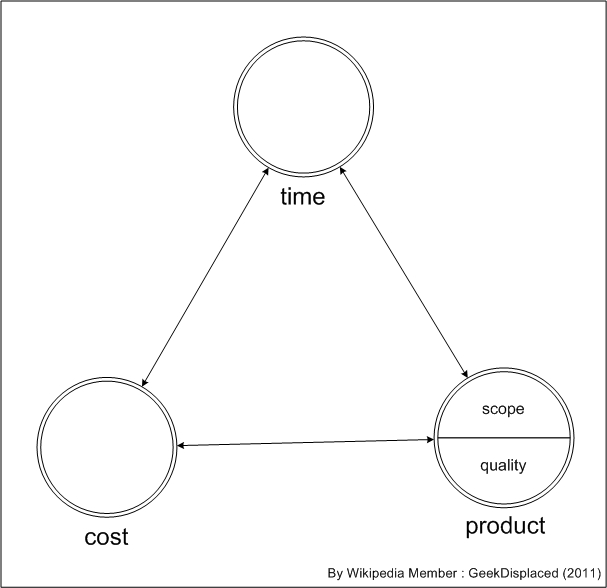
From time to time, the Population Health Blog likes to refer to this article on the "iron triangle" of health care reform. Using classic project management theory, it suggests health care planning is:

a) bound by 1) cost, 2) quality and 3) access, and

b) if there are limited resources, health system planners can only optimize two out of three.

Want to decrease costs?  Either quality will go down or access to care will decline. 

Want to increase access?  Docs and operating rooms will spend less time with patients (quality will suffer) or costs will go up, because you have to hire more docs or build more operating rooms.

Suppose you want to increase quality?  Because most interventions that increase quality are not free, it'll cost you.  Alternatively, fixed budgets and resources will have to be tasked to additional needs, so access will suffer.

It's admittedly simplistic, but this framework can be used even by the amateurs in the White House to better define the Veteran Affairs scandal. As the PHB understands it, VA administrators wanted to increase quality (more primary care, better mental health services), but they didn't have the budget to match it. Access declined and, voila, waiting lists developed.

Which brings the PHB to the insurers' dilemma.  The generous narrative is that commercial and government insurers can leverage "quality" and somehow increase access for more persons with insurance and/or "bend the curve" of cost inflation.  The "iron triangle" says that's not true and the PHB agrees.

That's because:

1) while it's possible to statistically assess outcomes in primary care settings, there is a shortage of primary care providers.

2) it's far more difficult to statistically assess outcomes in specialty settings, where there are limited numbers of patients, fewer commonly accepted outcomes and a greater impact of patient variation.

In other words, quality is neutralized. That means health care is a two sided triangle.

Assuming quality is now constant, the PHB now has another reason to predict that insurers will have only two options in 2015:

1) increase access to care for more persons, but that means increasing, not decreasing costs. That means higher out-of-pocket costs for patients, or lower reimbursement for providers.

2) lower costs, but that means decreased access to care. Providers will refuse to contract or more restricted provider networks be created.

Image from Wikipedia

Tuesday, February 4, 2014

Cost, Quality and Access in Health Care: Are All Three Out of Reach? Really?

Maybe the Disease Management Care Blog has been wrong.  And maybe there are implications for health reform.

The DMCB explains.

When it lectures at population health conferences, it patiently explains that health care data analytics will always involve trade-offs between speed, accuracy and detail.  For example if it wanted insight on the quality of care for a cohort of persons with diabetes, it could want the results tomorrow (speed), that captured 100% of the population (accuracy) and included standard deviations as well as age and sex breakdowns (detail). 

Analytics always must decide to pursue two out of three.  For example, the DMCB might want detail and accuracy, but that will take extra time. 

And so it goes.

An example from a parallel universe is the automobile market.  One Mr. Ford got past selling cars that were any color the customer wanted so long as they were black, Detroit infamously forced consumers to make trade-offs in speed, safety, gas mileage and quality.

2014 may be a watershed year where much of the DMCB's trade-offs are false choices. 

Bob Dylan argues that global consumers can have speed and safety and mileage and quality; he may have a point.

Returning to the health care industry, the DMCB wonders if the electronic record's expanding ability to capture patient detail combined with logarithmic growth in computational processing power will give providers the ability to hit "Ctrl-F1" and get an immediate, detailed and comprehensive on-screen report on the status of all persons with a particular attribute, like the presence of diabetes.

Which brings the DMCB to the infamous health care "iron triangle" of quality, access and cost.  The DMCB believes that the re-emergence of narrow insurance networks is simply a trade-off of access in exchange for quality and cost.  On the other hand, if consumers demand access and quality, they might have to settle for the high out-of-pocket costs of a stinky "bronze plan."

But here's the rub.  If Detroit can move the needle on automobiles and if the electronic record and supporting infrastructure is finally reconciling speed, accuracy and detail, who says the health care industry won't eventually crack the quality, access and cost conundrum?  The DMCB thinks it may take a while (Detroit took decades) but if the current pain over Obamacare eventually results in getting all three, maybe it will have been worth it.  Maybe it is within reach.

Just maybe. We'll see.