Welcome to this October 2014 edition of the Health Wonk Review, hosted by your Disease Management Care Blog. The Review is a sampling of the best recent postings by thoughtful health policy bloggers who are offering insights about healthcare delivery, insurance and reform that are outside the media mainstream.
Or White House control.
While Mr. Obama would like the bloggers to sit down, be quiet and let the Washington's expert political class get on with the people's work, the DMCB respectfully disagrees. It was the
bloggers who were sounding the earliest alarms about the dysfunctions of the federal health insurance exchange. Despite the advice of our President, this edition of the HWR proudly offers readers some important insights, additional warnings and lessons learned.
One of those lessons is that the HWR bloggers should be read
more, not
less.
Of course, this Review is not just about the exchanges. If that bungled bit of bureaucracy doesn't pique your interest, read on and you'll find other great stuff on health reform, pharmaceutical costs, Medicare's well-meaning ability to impose silly regulations on docs and how that horrific Bangladesh garment factory fire didn't really lead to any meaningful worker safety reforms.
First up, the exchanges.....
Joe Paduda of Managed Care Matters says the Obama Administration's roll out of the exchanges failed at several levels. Let's face it, he says, the development process was politicized and, as a result, consumers were given the green light to use a flawed web site. They're now being forced to enter too much data before they can shop for insurance, server capacity is insufficient, links to participating insurers are dodgy and patients are unable to ascertain if their doctor is in a particular network. He believes the best way forward is to completely redo the web site and to never ever forget what happens when politics trumps common sense. It's so bad, says Paduda, that the only reason not to fire HHS Secretary Sebelius is the prospect of another partisan battle over her replacement.
"Ouch!" says the DMCB.
For crying out loud, says
Tim Jost in the Health Affairs blog notes, we're talking about a web site, not cold fusion. While all eyes are on the individual mandate, Jost isn't worried because that's assessed on a monthly basis and the ACA allows for "hardship" exemptions. He reminds us that the key deadline date of December 15 is months away. That's the last day that individuals can enroll in time for the subsidies that will be in place on January 1 2014. If deadline is not met, it's possible that millions of Americans will be unable to obtain affordable insurance. The good news is that the Feds have broad discretion to extend enrollment periods as well as provide commercial insurers with additional assistance. Jost is confident that with the right amount of creativity, health reform can continue.
After reading this, the DMCB predicts HHS's creativity will include delaying the individual mandate without "delaying" the individual mandate.
John Goodman is less optimistic.
He uses his eponymously named blog to remind us that if only the sickest and most persistent Americans successfully use the exchanges, Obamacare may precipitate numerous insurer death spirals. State risk pools are closing, employer-based plans are closing, and individuals can now exit their "job lock." John predicts the sickest of these individuals will find the exchange's "gold" and "platinum" insurance plans to be relative bargains. Goodman offers some potential solutions, including flattening the subsidies, prohibiting dumping of the sickest members by insurers, requiring COBRA benefits to be exhausted first and stopping enrollees from gaming the system by enrolling at the last minute.
It's the risk pools stupid!
Sean McGuire of Health Reform Explained coins the new catchphrase "nerd herd" to describe the exchange's "tech surge" repair. Despite the impressive-sounding term, he doubts the website code will be successfully rewritten any time soon. He wonders if the Feds shouldn't completely outsource to the states, because they have the track record and, with sufficient financial support, the resources to fix this problem.
Code woes prompt geek fleet.
Hank Stern of the Insure Blog builds off another blogger's observation that one reason why the exchanges are not performing well is because HHS wanted to shield users from seeing the cost of their insurance prior to the calculation of the income-indexed subsidy. For us wannabe techies, this is known as a "no wrong door" approach to web portals.
What HWR review is complete without a catch phrase you can use to impress your friends and stymie your enemies. And you're welcome.
So, how's health reform going?
Louse Norris, writing in Colorado Health Insurance Insider blogs with first-hand knowledge about a wrinkle in the ACA that allows for early renewal of existing insurance policies. As the DMCB understands it, this pushes back the day of reckoning when persons have to "buy up" to standard insurance benefit packages that may be more expensive than the "skinnier" policies that have lower out-of-pocket expenses. While some unnamed policy makers think that's a loophole, Louise thinks it's a good idea because, for her family - and many other Americans - that translates into hundreds of dollars a month in savings for 2014.
What other loopholes are there?
Maggie Mahar of the Health Beat Blog points out that the commercial insurers were at the table when the final details of the Affordable Care Act were hammered out. They
agreed to shelling out new
fees and taxes to help fund the legislation. Despite that, however, skeptics were suspicious that Mr. Obama had been too accommodating to the insurers. According to Maggie, we now can say with certainty that the skeptics were wrong. The commercial insurers' stock prices are now tanking because the investors are only now discovering, among other things, that pre-existing conditions cannot be used against patients, administrative costs are limited, preventive care now has first dollar coverage, lifetime caps no long exist, that they have to cover a standard benefit and state regulators are finally "getting some spine." She thinks the investors made two mistakes that she perceptively avoided: along with Ms. Pelosi, they didn't read the bill and they were confident that Mr. Obama wouldn't be re-elected.
The DMCB wonders if investors are also worried about the commercial for-profits being battered by death spirals.
Never mind
high tech, how about payment reform leading to
high touch?
David Harlow of The Health Blawg argues that the evidence that transformed primary care can save money is reaching critical mass. Primary care clinics that invest in systems of care may cost more in the short run, but the downstream cost savings are considerable. As fee-for-service continues to unravel, Harlow predicts these preventive and care coordination business models will become even more compelling.
Which prompts the DMCB to provocatively ask if this could this also be an argument for the monthly fees commanded by the "concierge" practices?
For those of us who think there may be market solutions that can reinvigorate medical education, Roy Poses of the Healthcare Renewal blog says it's time to think again. Roy looks at some of the "outcomes" from one off-shore for-profit medical school that caters to U.S. students, including the entry of venture capitalists, the creation of shady tax shelters, deans with jet-setting lifestyles, Swiss bank accounts, laundering money and the mysterious disappearance of school Presidents once the indictments start to roll.
As Roy has pointed out, however, on-shore and not-for-profit medical enterprises are not immune from bad behavior either. Health care bubble, anyone?
Brad Flansbaum of The Hospital Leader blog examines the impact of the Medicare regulation that post-hospital home health services can only be prescribed during the course of a "face-to-face" visit. For doctors getting their patients out of the hospital, this has resulted in one more form that needs to be completed (typically by someone other than the doctor) and then signed (by the doctor).When added to the press of other things that have to happen, the result is a discharge of a thousand cuts.
The DMCB's colleagues have lived with these and other unpleasantness that comes from being on the business end of Medicare. And people wonder why docs are leery about a single payer system?
Drugs!
Jason Shafrin of the Healthcare Economist blog describes how the Italian city of Naples recently saved 20 million euros in pharmaceutical costs. There was no single solution, but a combination approaches that may hold lessons for the United States. They include direct purchasing of drugs by patients, providing a supply of necessary medicines when patients leave the hospital, accepting generic drug names for prescriptions and making patients pay the difference when they insist on a brand-name drug. That doesn't mean that Italy's cost problems are automatically solved. New agents are constantly coming on line and the Italians do recognize that manufacturers need to recoup their development costs. That's OK, however, because Italy uses multiple administrative levels of review for efficacy, a rigorous "pay for performance evaluation process and "soft" spending global limits. In the end, if a drug is worth it, they'll pay for it.
U.S. drug company executives may end up taking some of their own products if this system gets adopted here.
If reports are true,
David Williams of the Health Business Blog points out that the Food and Drug Administration's public service mission is being undercut by the "invitation-only" meddling of pharmaceutical companies in the Agency's pain management evaluation meeting panels. Either pharma should get out, says Williams, or other legitimate stakeholders, like patients, payers, academics, advocacy groups and other government agencies should also be in the room.
So, with news like this, why is bloggery a bad thing?
And last but certainly not least.....
We all remember that horrendous garment factory fire in Bangladesh that killed over a thousand workers. If you still enjoy wearing that name-brand clothing, you won't want to read
Julie Ferguson's summary and review of a multi-part series of articles on the topic appearing in Workers Comp Insider. If you do, you'll either want to go naked or start paying attention to which retailers have truly committed to international worker safety. Unfortunately, it appears that most continue to put low-cost fashion as their number one priority, even if it means putting more lives at risk.
Behold the health implications of our throw-away clothing life style. Maybe it's time to reward clothing manufacturers that offer products made in the U.S.A.
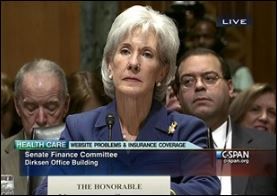 The Disease Management Care Blog spent part of its day in front of its internet enabled World Headquarters' computer screens. As a result, it was able to tune into todays dreary Sebelius Senate Finance Committee testimony.








 Posts
Posts