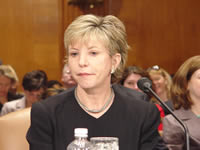
 While HHS Secretary Sebelius reassures the House Republicans that the Fed's health insurance exchanges are on track, that the implementation of the Affordable Care Act will not be a "train wreck" and flies around the country touting Obamacare, Disease Management Care Blog readers may want to check out this 3 page article by the notorious anti-Sebelius a.k.a. AHIP's CEO Karen Ignagni. In it, she mounts a vigorous defense of her trade association's commercial insurer members.
She points out:
1) Commercial insurers' versions of accountable care organizations include a variety of prospective payment approaches that are tailored to the provider's willingness to take on insurance risk. What's more, commercial insurers can "calibrate" the benefit so that consumers', physicians' and hospitals' economic incentives are all aligned.
2) Health plans are quite able to share data and analytics support that translates into early identification of trends, accurate payment designs and the targeting of programs at patients who are at greatest risk.
3) AHIP's members are routinely providing health risk assessment tools, predictive modeling, medication compliance programs and care management services.
4) AHIP is well aware of the difference between true cost savings versus mere cost shifting. As a result, they are asking for greater transparency on commercial and government fee schedules so that the potential impact of cost shifting can be better understood.
5) While Washington DC deserves a lot of credit for promoting a quality agenda, it could do a better job of working with all insurers to come up with a set of universally used quality measures.
6) While commercial plans are required to use uniform billing systems, providers are under no obligation to submit their claims electronically. While this certainly helps physicians over the short term, the long term inefficiencies are not cheap.
7) Commercial insurers would rather cover treatments that have been shown to work. The "Patient-Centered Outcomes Research Institute" is not mentioned by name, but you get the idea.
8) AHIP supports letting non-physicians practice "to the top of their license."
9) State-based "laboratories of democracy" are a useful way to try out a variety of health reforms before they are adopted by Washington.
The DMCB's take?
AHIP and Karen Ignagni have been mostly out of the public eye. Could this be a sign that they're less wary of the Administration's anti-insurer bluster?
While Medicare's Innovation Center continues to get high marks, the commercial insurers appear to be advantaged by having more leeway to test new payment and care management strategies.
AHIP's members are aware that many providers could fold if they mismanage the risk that underlies prospective payment systems. Unike Washington's one-size fits all approach, they seem prepared to adapt their contracting accordingly.
Care and disease management programs? The commercial insurers have rolled this into standard operating procedure.







 Posts
Posts