Showing posts with label Donald Berwick. Show all posts

Monday, December 9, 2013

Follow-Up on Electronic Health Record Portals: We're Asking the Wrong Question (and the DMCB is guilty)

Researchers pondering the EHR portal
Thanks to Twitter, the @DisMgtCareBlog had a highly rewarding tweetologue with tweetociates @Paulflevy (with an insightful bit of bloggery here), @granitehead and @subatomicdoc about a recent DMCB post on the topic of electronic health record (EHR) patient portals. As readers will recall, yet another notion of the Lilliputian Order of Unquestioning EHR Believers failed to pass scientific muster when The Annals published a negative review on patient portals. Tweeples took note with a series of tweets that simultaneously advanced the DMCB's social media chops and the antipathy of the how-does-this-make-money? DMCB spouse.

To tell the truth, however, the skeptical DMCB took unfair advantage of this latest EHR kerfuffle. It confesses that it couldn't resist this latest addition to the target-rich environment of HIT disappointments in quality, cost and governmental overreach.

So, upon further reflection, just because almost 15 years of high quality research failed to establish any lasting value doesn't mean portals should go the way of the Dodo, low-cost medical malpractice insurance or Mr. Obama's credibility.

In other words, the DMCB does think that portals have a role to play in the health care reform landscape, and it said so in front of a huge audience at the recent Star Ratings Conference in Fort Lauderdale.

Portals, thinks the DMCB, have little value as stand-alone interventions. Just dropping it into a clinic's patient population is unlikely to significantly increase communication and shift behaviors enough to produce enough of a "signal" that cost or quality outcomes are better compared to usual care.

But when EHR portals are part of a multi-channel outreach strategy that includes (but is not limited to) mailings, interactive voice response-based calls, secure messaging, emails, social media, "anniversary" time-for-your-appointment cards, live telephony as well as home visits that are all backed by predictive modeling (who is at greatest risk) that informs "impactability" (how they're at greatest risk) that's all tethered to care management that is also closely aligned with marketing and builds brand, then portals mostly likely do add value.

Unfortunately, traditional health services research cannot assesses the multiple simultaneous interventions described above.  As Dr. Donald Berwick presciently noted in this classic JAMA article:

Experimentalists have pursued too single-mindedly the question of whether a [social] program works at the expense of knowing why it works. Thus, although [traditional research] seeks generalizable knowledge...it relies on removing most of the local details about “how” something works and about the “what” of contexts. It therefore reveals little about mechanisms or about factors that affect generalizability. Studying a few covariates, or using stratified designs, or probing for interactions can mitigate this loss, but these are inadequate tools for studying complex, unstable, nonlinear social change.

As the DMCB has noted before, absence of any proof is not the same as proof of absence.  The studies that the DMCB ultimately quoted were based on traditional research, which is simply not up to the task of the non-linear intervention of patient-doc-team communications.

Don Berwick recommends a more insightful approach:

Health care researchers who believe that their main role is to ride the brakes on change—to weigh evidence with impoverished tools, ill-fit for use—are not being as helpful as they need to be. “Where is the randomized trial?” is, for many purposes, the right question, but for many others it is the wrong question, a myopic one. A better one is broader: “What is everyone learning?” Asking the question that way will help clinicians and researchers see further in navigating toward improvement.

When it comes to EHR portals, it's time we ask just what are we learning.

Tuesday, November 19, 2013

Dr. Berwick Discovers Toxic Politics Too Late

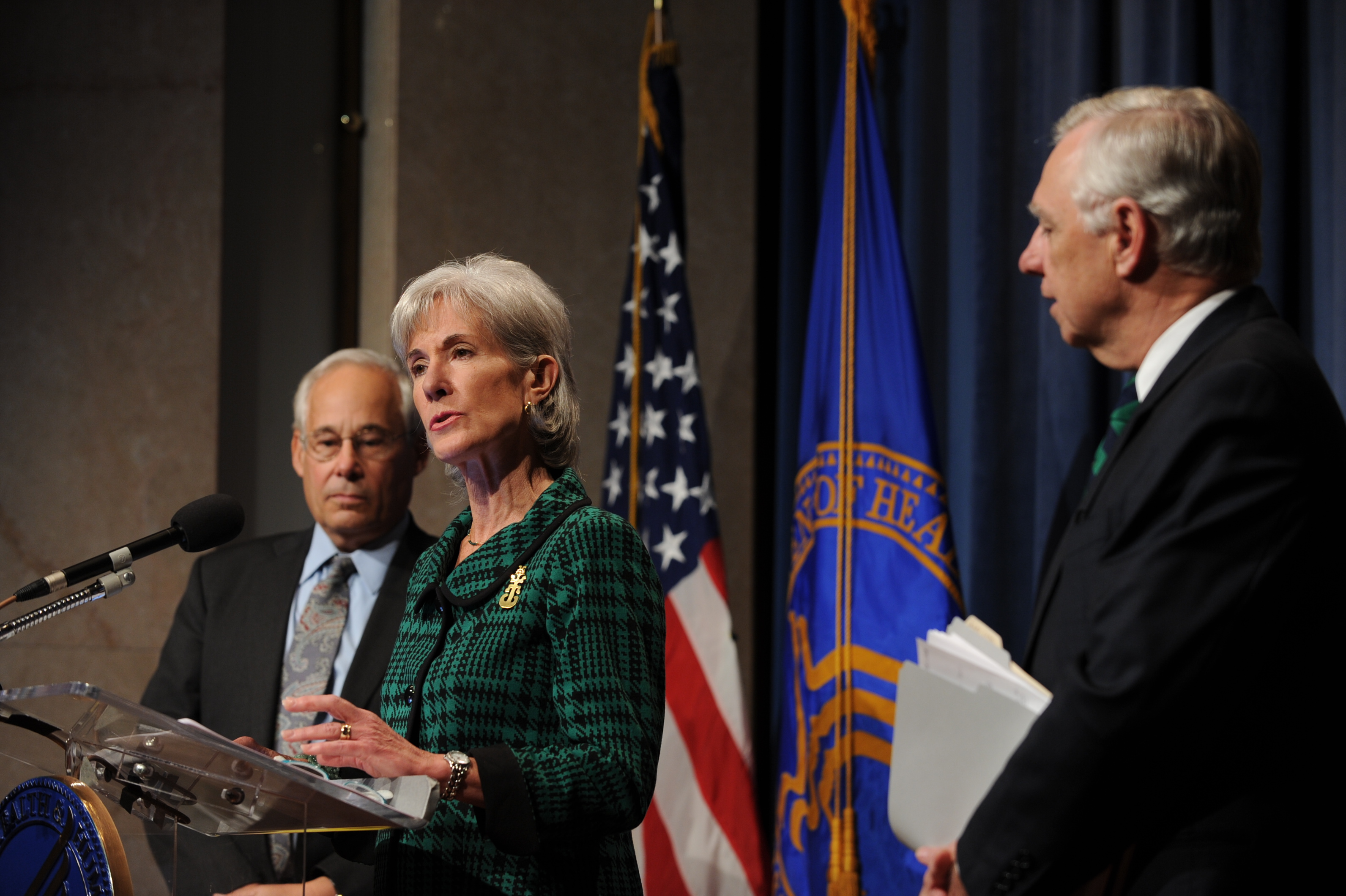
Dr. Berwick listens to Ms. Sebelius
If you're interested in a post-mortem of Dr. Donald Berwick's failure to be confirmed as CMS Administrator, check out his November 13 JAMA article on "The Toxic Politics of Health Care." 

He identifies six causes of our national discontent, which the social media-minded Disease Management Care Blog has boiled down into 140 character or less tweetable summaries:

Money: there are too many entities making too much money to give up on the status quo. "Reducing costs" means cutting into someone's income.

Unorganized majority latent interests: the majority of Americans can't see or translate their interests into effective political action.

The Silence of Professions: Organized medicine has been all about the SGR and tort reform.  They should advocate for health reform.

Suspicion of Science: public trust in science is eroding because of its elitism. That, in turn, feeds into fear of rationing.

Duality of self interest: a lot of people work in the health care industry. Cutting costs will add to U.S. unemployment woes.

Ambivalence about Federalism: it's difficult to develop a coherent national health policy when power is shared with the states.

Ambivalence about the poor: it's difficult to convince the U.S. electorate that disadvantaged populations deserve public support.

For the record, the DMCB openly supported Dr. Berwick's nomination and still feels that he would have ably served his country as CMS Administrator.  That being said, one cause for his undoing was his failure identify these issues before he was forced to leave Administration. 

Docs like Dr. Berwick - and that includes the DMCB - unfortunately think that all they need are the facts to win the day. Not so: they need to address the money, catalyze coalitions, nudge stakeholders, reconcile multiple interests, cut deals and still do what's right.

He was the wrong guy at the wrong time.

Wednesday, September 4, 2013

Real News Headline: Improved U.S. Health Care System Saves 28,000 Lives in 2010, Avoidable Death Rate is Decreasing

Health reporters at work
When the major news media organizations (for example, here and here) proclaimed that 200,000 cardiovascular deaths in the U.S. could be avoided every year, the Disease Management Care Blog decided to learn more.

The information reported in the media was taken from the Centers for Disease Control and Prevention's Sept. 3 Morbidity and Mortality Weekly Report. As the DMCB understands it, the CDC authors pulled 2001-2010 mortality data from the National Vital Statistics System. Once that was done, they counted up the number of persons aged less than 75 years who died of "ischemic heart disease," "cerebrovascular disease," hypertensive disease" or "chronic rheumatic heart disease."

So what did MMWR really say?

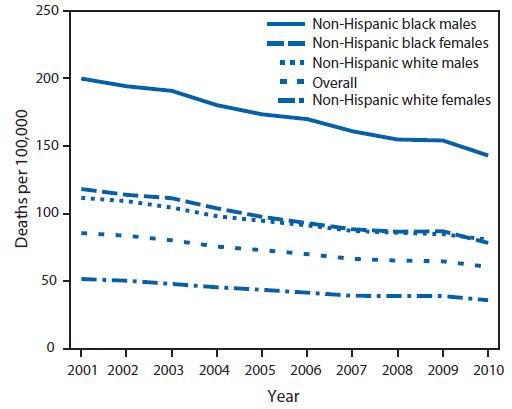
The total of "less-than-75" deaths in 2001 was 227,961.  For 2010, it was lower at 200,070. Since the population in the U.S. has changed over the last decade, the totals for each of the two comparison years were then expressed as a "per 100,000" statistic.

Since 2001, the "less-than-75" death rate per 100,000 declined by 29%.  The decline averaged 3.8% a year.* Persons age 65-74 years had an average decline of 5.1% vs. 3.3% persons between the ages of 55-64. 

The good news is that Black (3.9%) and Hispanic (4.5%) persons had greater declines than whites (3.6%). The bad news is that they started and ended with a higher death rate.

Here's a visual display of the data:


 The DMCB's take

1. "Avoidable?" The CDC definition implies that perfect control of all cardiac risk factors (for example, cholesterol and weight) for everyone under the age of 75 will result in a 0 per 100,000 cardiovascular death rate. Not so, because those risk classic factors capture some, but not all, persons who succumb to heart attack and stroke.

2. So, this is bad news?  "200,000" deaths is an impressive number, but, on an unadjusted basis, that's about 28,000 fewer compared to 10 years ago. Some additional good news is that the U.S. rate of non-fatal heart attack and stroke appears to have dropped significantly alsoWe are making significant headway in the battle against heart disease.

3. The real story? Persons of color have had the greatest relative benefit but still have the greatest absolute need.  That lingering health care disparity went shamefully unmentioned by CNN and was only briefly mentioned by USAToday.

4. Something for everyone: In their "Conclusions and Comments," the authors of the MMWR paper speculated on the benefits of the (still unproven) Million Hearts Initiative (a Berwick-era idea) as well as "health information technology" and various "community prevention strategies" The DMCB's colleagues in the care management service industry will really like the authors' nods toward "team based care" and how "individuals can work toward reducing their own heart disease and stroke risk."  If the CDC says so, it must be true - assuming there's a good business model.

5. Speaking of speculation, the authors wondered if the greater decline in the Medicare age group (65-74 years) versus the younger age group (55-64) was because of the presence of health insurance. Maybe, but maybe not.  The DMCB also wonders if heart disease is more lethal and less amenable to intervention among younger persons, but can't find any literature to back that up.

6. Politics intrude:  Naturally, the scientists who write MMWR are too classy than to curry favor with the appointees that populate the upper echelons of the federal bureaucracy, but that didn't stop the CDC Vital Signs from shamefully putting in a "making it easier for Americans to afford regular preventive health care through the Affordable Care Act" plug.  The ACA was not mentioned in the MMWR report because the declines mentioned above occurred in the absence of the ACA

The DMCB predicts that when the "avoidable" death rate continues to decline by 3.8% in the coming years, Obamacare advocates will take the credit.


*The DMCB isn't sure how 3.8% for 10 years makes for 29% either, but that's statistics for you.

Image from Wikipedia

Tuesday, July 2, 2013

What Can World War Z Tell Us About Accountable Care Organizations?

Unable to resist the allure of another zombie movie, the Disease Management Care Blog saw World War Z.  While the gruesome scenes of chomping and stampeding hoards of infected undead were cinematic eye candy, the DMCB was undeterred.

It was naturally thinking about accountable care organizations and how they compare to zombies.


                                     Zombies                           ACOs

Premise:                      Undead                           Unproven

Spread via:                   Bites                                 Hype

The Hero:                 Brad Pitt                         Donald Berwick, MD

Why Worry:         The U.N is in charge             C.M.S. is in charge

Initial Response:      Offshore boats                  Offhand hope

Best managed
by..........                  Fleeing                            Fleeing

DMCB spouse
perspective........          Gore                             Bore

Confronted by
hoards of attacking                                   Refer to PCPs, wait
undead you.....        Toss grenades           years for shared savings

Diet:                         Bared brains                    Shared gains      


Image from Wikipedia 

Monday, March 4, 2013

Health Reform and Capitation 2.0

New recipe for capitation?
Readers of Kaiser Health News, Politico and The Hill (here, here and here, respectively) were treated to the faux news of another expert report on the tedious topic of physician payment reform.  While the Disease Management Care Blog is a big fan of the brainy Society of General Internal Medicine (SGIM), this physician compensation communique is another rehash of "misaligned incentives" leading to "quantity over quality."

Yawn.

The good news is that there may be insights that were missed by KHS, Politico and The Hill.  In this instance, the DMCB has been listening closely and found one thing the experts aren't saying.

What was said?

Like the many other decrees that have preceded it, the Report of the National Commission on Physician Payment Reform recommends the recalibration and then phasing-out of stand-alone fee-for service (FFS) while transitioning to other payment models that blend FFS with global payment, salaries or "capitation."  It also advocates increasing payment for "congnitive" over procedural services, removing any hospital overhead costs from the fees that are paid for any service that can also be performed at a free-standing facility, rewarding measurable quality, paying for telemedicine, increasing the use of risk adjustment, repealing the sustainable growth rate (SGR) and reforming the RUC.  And like everyone else, it assures the reader that paying for the savings from all these reforms will more than pay for themselves.

And yes, the word "capitation" was in the report.

What isn't being said is that there is a growing consensus that scuttling of traditional fee-for-service will usher in a new era of capitation.  The DMCB thinks of it as Capitation 2.0.

"Capitation" doesn't necessarily have a good name, but that doesn't mean this new rose doesn't smell as sweet or have fewer thorns. Originally spawned by the go-go managed care era of the 1990s, it was blamed for putting profits before patients by giving physicians an incentive to withhold needed medical services.  While a much younger Donald Berwick reported that the medical literature "did not make capitation out to be the villain that some believe it is," the complex risk taking, a lack of individual physician support and unseemly group practice behaviors undoubtedly fueled the physician backlash and the end of managed care in the 1990s.

 So why is capitation coming back?  The DMCB suspects one reason is that there are only passing references to it and that it's been rebranded with more benign sounding names like "gain-sharing" and "global payments."  Another is Medicare FFS fatigue, caused not only by the SGR but by CMS' unending hassles, the uncertainty surrounding PQRS and the dread of having to go through one of those repugnant "RAC audits."  Unwilling (so far) to simply drop out of Medicare altogether, docs are backing into acquiescing to the recommendations of groups like the SGIM.

And why does the DMCB call it Capitation 2.0? Writing in SGIM's Journal of General Internal Medicine more than a decade ago, Thomas Bodenheimer predicted the survival of managed care thanks to the allocation of full capitation to institutions, not individuals. It's then up to those institutions to leverage both FFS and capitation at the individual physician level.  The DMCB would add that a third ingredient is tying any payments under capitation to specific quality goals, like control of chronic illness or maintaining access to care.

The DMCB's conclusions?

What they didn't say: The track record of original capitation or advent of Capitation 2.0 doesn't mean physicians are embracing what their organizations and political allies are saying what's best for them.  They simply don't see an alternative. The 1990s could happen again.

What they got right, sort of: Outside of large organizations that take capitation, we have much to learn about the best combination of FFS and fixed payments when it comes to physician incentives and protecting patients.  Like other reports before it, the National Commission suggests we need 5 years to assess new payment models.  Given the decades of experience with managed care's capitation and Medicare's institutional inertia, that may be overly optimistic.

Thursday, November 24, 2011

Who Is CMS Administrator Marilyn Tavenner and What Does Her Nomination Mean?

Say hello to the CMS Administrator
Bowing to the implacably oppositional Republicans, President Obama's first selection for Administrator of CMS tendered his resignation and made way for second-in-command Marilyn Tavenner.  What's more, instead of using a recess appointment, the White House has submitted her nomination to the U.S. Senate.

So who, asks the Disease Management Care Blog, is she?

According to this biosketch (scroll down, you'll find her), Ms. Tavenner has a 25 year hospital administrator pedigree that includes being CEO at two Virginia Hospital Corporation of America hospitals (Chippenham and Johston Willis).  That part of her career culminated in her being the company's "President of Outpatient Services."  As the DMCB understands it, she entered the major leagues of public service in 2006 when Democratic Governor Tim Kaine tapped her as Virginia's Secretary of Health and Human Resources.  Thanks in part to her links with Mr. Kaine, she later jumped to CMS, where she became the "Principal Deputy Administrator and Chief Operating Officer."  Unsurprisingly, her duties have included loyally defending the Affordable Care Act (ACA).  You can see her in action here on C-SPAN.

By the way, did the DMCB mention that Ms. Tavenner is a registered nurse?

She has an Virginia Commonwealth University BSN undergraduate degree and apparently climbed the HCA ranks one patient care unit at a time.  Somewhere along the line she also nabbed a Masters in Health Administration.

Four initial thoughts from the DMCB:

1. The new CMS nominee is another example of the emergence of nurses as go-to health leaders.  Not only does the public trust them, they're able to bring a real-world understanding of hands-on patient care to the high falutin' mix of operations, policy, politics and finance.  The good ones know how to deal with grumpy doctors and neutralize clueless administrators.  That being said, the physician DMCB can't help it and still wishes there was a doc at CMS' helm

2. In its long career, DMCB has witnessed the Dark Side Transformation of many well-meaning physician or nurse administrators to a type that places profits over patients. What's more, few have become hospital CEOs without making some enemies along the way.  Will any past foes come forward with unpleasant anecdotes from an otherwise forgotten past?  Stay tuned.

3. Despite lots of searching, the DMCB couldn't find much of a track record outside some speaking gigs and serving on some boards.  As far as it can tell, she has no peer-reviewed publications and her public statements have been pretty vanilla.  While that may impair Mr. Obama's foes' ability to attack Ms. Tavenner's record, the DMCB wants to know more about someone who is going to be leading the world's largest health insurer.

4.  The absence of a track record doesn't mean that the nomination process isn't an opportunity for politically motivated mischief.  It remains to be seen how well Ms. Tavenner testimony holds up to the Republicans' intense "gotcha" scrutiny and whether her nomination ultimately becomes a toxic partisan (re)hearing on the merits of the ACA.

Sunday, March 6, 2011

An Open Letter Regarding Dr. Berwick's Nomination

The Disease Management Care Blog has written to its U.S. Senator, Pat Toomey (R-PA) regarding his recent signature on a letter to President Obama urging that Dr. Berwick's nomination to lead CMS be withdrawn. An edited copy of the letter is below:

The Honorable Pat Toomey
B-40B Dirksen Senate Office Building
Washington, DC 20510

Dear Senator Toomey:

As a Pennsylvania physician and voter, I am writing concerning the March 3 letter to President Obama that you co-signed along with 42 other U.S. Senators regarding Dr. Berwick’s nomination as the CMS Administrator. In that letter, you ask the President to withdraw Dr. Berwick’s nomination because of several concerns.

I urge you to reconsider and support the Senate’s prompt consideration of Dr. Berwick’s nomination. I am confident that when his credentials and track record are reviewed, that you and a majority of US Senators may find him to be an excellent choice for CMS Administrator.

I’ve outlined each of the concerns mentioned in the letter and address each one below:

A “contentious” nomination: It’s safe to say that any selection by the Democratic Administration in this time of hyper-partisan jujitsu would have been roundly condemned by the opposition as one step short of an impeachable offence. It’s obvious to any voter that there is plenty of blame to go around for the contentiousness.

Failure to respond to repeated requests for information: Now that the Congressional playing field is more level (thanks, in part, to your recent election) and Washington has heeded the call for more cooperation, isn’t it safe to assume that future requests will be honored? Why not ask again and see what happens?

Recess appointment: I would submit that that is a symptom, not the problem. Giving Dr. Berwick’s nomination the serious and deliberate consideration it deserves could be one step toward reducing the misuse of recess appointments in the years to come.

Past record of controversial statements: Most that are being mentioned in the press are the result of being taken out of context or being selectively quoted. The sum total of Dr. Berwick’s commentary over decades of scholarly work is insightful, evidence-based and rhetorically moderate.

Lack of insurance experience and management ability: Ask any physician, and they will tell you that there is much about CMS that is broken. That may be precisely why an outsider is the best person at this time. In addition, Dr. Berwick, over the course of his storied career, has advised and partnered with countless health insurers on initiatives that promote high value care. Last but not least, Dr. Berwick’s recent public comments suggest he handling the steep learning curve quite nicely.

I’d like to also point out that Dr. Berwick’s recent appearances at a number of forums including The Brookings Institution and the National Advocacy Conference of the AMA demonstrated that he has good insight, can garner the support from a wide political spectrum and, most of all, is his own man. There is little that is truly “political” about him.

As a voter who is dismayed at the lack of cooperation inside the beltway, I can’t help but wonder if part of the calculus in opposing Dr. Berwick’s nomination is the political advantage of seeing Mr. Obama humbled. While I share many concerns about Mr. Obama’s decision making, I urge you to fight those battles elsewhere and spare CMS from the gamesmanship.

Let Dr. Berwick come forward. You may be in for a pleasant surprise. Heaven knows your voting supporters could use one.

+++++++++++++++++++++

March 7 update: Senate Democrats have given up on confirming Don Berwick as CMS administrator in the wake of a letter from 42 Republican senators opposing the nomination, sources tell POLITICO.

Monday, September 6, 2010

Where To Put All That Money......

The Disease Management Care Blog figured Don Berwick would keep a low profile. Yet, thanks to this update from Kaiser Health News, the DMCB caught up with with the healthcare brouhaha in the body politic. In addition to declining interview requests for interviews with the Boston Globe, Dr. Berwick's been busy managing the billions of dollars of research/demo hyperalimentation for our academic-industrial complex. The tone of the Globe article suggests that Dr. Berwick's Boston groupies are already measuring the drapes for their new research office wings.

Yet, assuming Dr. Berwick is interested in eventually securing a U.S. Senate confirmation, the DMCB calculates it would be politically savvy to keep most of the Affordable Care Act booty out of Massachusetts. It won't take much (relatively speaking, hundreds of millions is not a lot) to appease his posse and make Sen Scott Brown (R-MA) think twice about voting against him. The smart money says to swing the billions toward the States with potential Senate allies in his upcoming confirmation hearings: moderate Republicans and wavering Democrats.

Which is the problem. Despite Dr. Berwick's reputation for scientific excellence, he'll inevitably have to struggle with conflicts of interest - between allocating precious national treasure on the basis of scientific merit and granting pork on the basis of holding onto political power. Welcome to their world, Dr. B.

The DMCB predicts this will be one of the more interesting stories of the fall health reform news cycle. Where will all that money go and how will a sympathetic news media, Dr. Berwick's allies, his critics and, most importantly, the U.S. Senate respond? Stay tuned.