While readers digest the reality of a Trump Presidency and Republican control of both houses of Congress, the Population Health Blog (PHB) has been trying to assess the "down ballot" implications for healthcare and mHealth providers.
While the universe has been turned upside down, its initial reaction for mHealth is bullish. As for the rest....... read on.
While he was a wacky campaigner, the PHB suspects that Mr. Trump's "campaign promises" were really opening negotiating positions. While immigration, the Supreme Court and business regulatory reform will be top of mind, he'll eventually get around to making deals in the healthcare space, because that is his nature. That is the real wild card and increases uncertainty.
That being said, what can the PHB predict?
Given Mr. Trump's and the Republican majority antipathy to Obamacare, the Affordable Care Act is likely to be gutted. While U.S. Senate Democrats can create mischief with the filibuster, many are also up for election in two years. As a result, commercial insurance premium subsidies, the minimum benefit, the IRS penalty and ACOs are toast.
Because it's working pretty well, the PHB rates it as unlikely that Congress will alter the basic underpinnings of fee-for-service Medicare and the Medicare Advantage programs. Unfortunately, however, that also means that the complex reporting and payment changes of MACRA - and its premise of "value-driven" Medicare - will stay on track.
According to The Washington Post, more of the federal support of Medicaid will transition to block grants. The PHB suspects that when the budgeting is done, the Republicans will trade greater local leeway for less money. It remains to be seen how states will respond by altering eligibility requirements.
So, over the short term who wins and who loses?
Patients lose - but slightly: those who are outside of Medicaid, many of them will buy skinnier coverage or not buy any commercial insurance. While that will mean that many will forego needed medical care, Obamacare's deductibles were already leading in that direction. Those in Medicaid will find their healthcare coverage dependent on their state's fiscal priorities; on the other hand, many Governors will fight to do the right thing. Medicare patients will do OK. The good news is still that if anyone shows up at 3 AM with motor vehicle trauma, the system will still take care of them.
Hospitals/Inpatient Service Providers lose and a lot: Without premium subsidies, more persons will forego commercial health insurance, and Medicaid will have less money. Since a lot of inpatient healthcare utilization is preference insensitive, that means more bad debt and deeper fee schedule discounts. By the way, interest rates are destined to rise, making hospital debt more expensive. They'll consolidate, and a pro-business climate in D.C. may make this easier.
Physicians neutral: while physician incomes will also be buffeted by more bad debt and deeper Medicaid discounts, the PHB suspects a critical mass of docs were increasingly disenchanted with Obamacare and its impacts on their professionalism. While policymakers and organized medicine groups (such as the AMA) may argue that this is a Pyrrhic Victory, all of this will be overshadowed by the top line impacts of MACRA, which is not going away. This will quickly eat up the docs' bandwidth. They'll continue to consolidate into larger groups, but away from hospitals, which can no longer afford them.
Organized Medicine loses: the AMA and many of its sister organizations supported Obamacare and stayed inside the Beltway Bubble. Eight years later, those chickens are coming home to roost. They now have to choose between being part of a new solution or being a member of the loyal opposition. Both are unpalatable.
Health Technology/mHealth wins: patients will look for tech solutions that offer faster, cheaper or better care that include, for example cloud-based guidance for diabetes control, remote provider advice web sites and home telemonitoring. To the degree that it offers a substitutive level of care, insurers will gladly pay for it, and since there are revenue opportunities for providers, they'll pay for it too. A pro-business posture in Washington DC, a focus on other healthcare issues and less regulatory overhang means that apps, devices, gadgets, big data, The Cloud and SasS will continue to expand. The future remains bright for companies like MedSolis.
Long term? This depends more on the economy. If it can return to 3% growth and if the labor participation rate increases, more persons will be able to afford housing, transportation, education and healthcare.
Showing posts with label mHealth. Show all posts
Showing posts with label mHealth. Show all posts
Thursday, November 10, 2016


Thursday, April 7, 2016
A Presidential Politics-Free Health Wonk Review
Welcome to the Health Wonk Review, a compendium of the latest insights from more than two dozen health policy blogs. Each HWR issue is hosted at a different participant's blog, with topics that include health policy, delivery infrastructure, pharma, insurance and information technology.
Your HWR host, the Population Health Blog, uses a skeptical physician's perspective to write about "systems" of care. Lately, it has focused on mHealth interventions that influence clinical and economic outcomes at a "population" level, as well as the effective governance of health enterprises.
It's also been a proud HWR participant for more than eight years.
The PHB is pleased that NONE of this issue's participants chose to mention any of the appalling lead candidates for U.S. President. Readers could use a break from the campaign cacophony, so the PHB welcomes you to the Presidential Politics-Free Health Wonk Review.
The Affordable Care Act - What are the numbers?
Charles Gaba of ACASignups has been tracking the progress of the Affordable Care Act. This ongoing labor of love led him to comb through too-numerous-to-count public domain sources to provide an original-sourced summary (with links galore) of the health insurance status for the entire U.S. population in one chart. He calls it "ambitious." The PHB calls it gloriously detailed, credible and superb. KHN, you've met your match.
Medicaid
Hank Stern of the InsureBlog reminds us that Medicaid fails to meet the true definition of "health insurance." While beneficiaries get their health bills covered, this payment system is a government program that is ultimately paid for by taxpayers. As this
#mHealth - or the PHB is going to need an app to manage all its patients' apps.....
Peggy Salvatore of the Health System Ed Blog provides a summary of the ePharma Summit 2016 and regales readers with descriptions of how eHealth is helping persons who have gastrointestinal disorders, cancer or complex medication regimens be placed at the center of care. "eHealth" is reaching critical mass without the help of any government mandates or meaningful use requirements. Imagine that.
David Harlow of the HealthBlawg takes a bite of Apple's CareKit Platform by unpacking the first app entrant from Iodine dubbed "Start." Start promises to help users to individually manage both the benefits and side effects of anti-depressant medications. The app relies on a validated depression survey to assess progress, promising to take the guesswork out of treatment.
Outcomes
Brad Flansbaum of The Hospital Leader not only summarizes "the best (peer-reviewed) study on (hospital) readmissions to date," but interviews the lead author. As many have suspected, a significant proportion of preventable readmissions are outside the control of the institution and practically all of the current public-reporting measures fail to take that into account. Two insights are that 1) readmission rates will never go to zero, nor should they and 2) innovative interventions to minimize the risk of readmission are just now being developed. The PHB predicts that soon, no at-risk patient will leave the hospital without a dedicated app and telehealth-linked handheld device. Given the dollars at stake, perhaps those patients without handhelds should be given one.....
Pharma Misbehavior
Roy Poses from Health Care Renewal pulls aside the curtain and exposes the persons ultimately responsible for the OxyContin fiasco. Members of Purdue Pharmaceutical's C-suite had to pay hefty fines for the company's allegedly misleading advertising, but the upstream owners seem to have escaped scrutiny with their gazillions intact. If any of this is true, we've learned nothing about combatting corporate misdeeds.
Health Savings Accounts
Jay and Louise Norris of the Colorado Health Insurance Insider Blog take a look at some of the arcana and paranoia emerging around health savings accounts (HSAs). First the arcana: HHS has a BPP about the HSA designation from QHPs that have otherwise been contrived to get around other regulations, likely promulgated in other BPPs. The paranoia is from wary conservatives, who are wondering if the liberals are unable to limit themselves to just "the nine words" by using BPPs to ultimately undermine HSAs. What could possibly go wrong?
Dual Eligibles
Tom Lynch of Worker's Comp Blog reviews the history of the successful Commonwealth Care Alliance. This non-profit HMO currently serves over 17,000 "dual eligibles" in Massachusetts; these persons have significant disabilities and therefore qualify for both Medicare and Medicaid. Despite huge claims costs, this HMO has been ably served by leadership who understands how money and mission underlie successful health insurance.
A Minimum Wage A Day Keeps the Doctor Away
California's Anthony Wright of the Health Access Blog is not only unapologetic about his home state gradually increasing the minimum wage to $15, he argues that that level of income correlates with better insurability, out-of-pocket affordability, higher health status, improved social determinants and less need for Medicaid. What's there not to like, especially since the 48 other states can see how this ultimately works out.
Drugs: You Don't Get What You Don't Pay For
David Williams of the Health Business Blog has some thoughts for the pharmaceutical industry's efforts to justify its drug pricing policies. He recommends that pharma not only embrace cost-effectiveness, but lead the fight to include that methodology in all things healthcare. They also need to help the public understand that you don't get good stuff for free: someone has to pay.
Speaking of Drugs....
Joe Paduda of the Managed Care Matters blog attended the Rx Drug Abuse Summit and has posted some of the more scary data that was presented there. The vast majority of heroin users started with prescription opioid drug abuse and a lot of smart concerned people are mobilizing to address the problem. Awareness is the first step in addressing this unmitigated disaster.
And saving the best for last, in the Health Affairs Blog, Peter Doshi, Kenneth Mandle and Forence Bourgeois scrutinize the CDC's recent recommendations on the treatment of influenza with antiviral drugs. After contrasting the recommendations with the FDA's and others' more detailed analyses on the subject, the authors find the CDC's promotion of a drug of questionable effectiveness to be "problematic." In academic speak, them's fighting words. This ain't over, so sit back and enjoy while the flu fur flies.
Your next Health Wonk Review will be hosted by the Health System Ed blog on April 21.
Thursday, March 17, 2016
Busting Through the Healthcare Performance Frontier
 |
| Breakthrough! |
The costs of business performance - for example, customer delight, reputational excellence, high worker satisfaction, workplace safety, leadership diversity, environmental sustainability or reducing social disparities - are typically viewed through the lens of a zero-sum game.
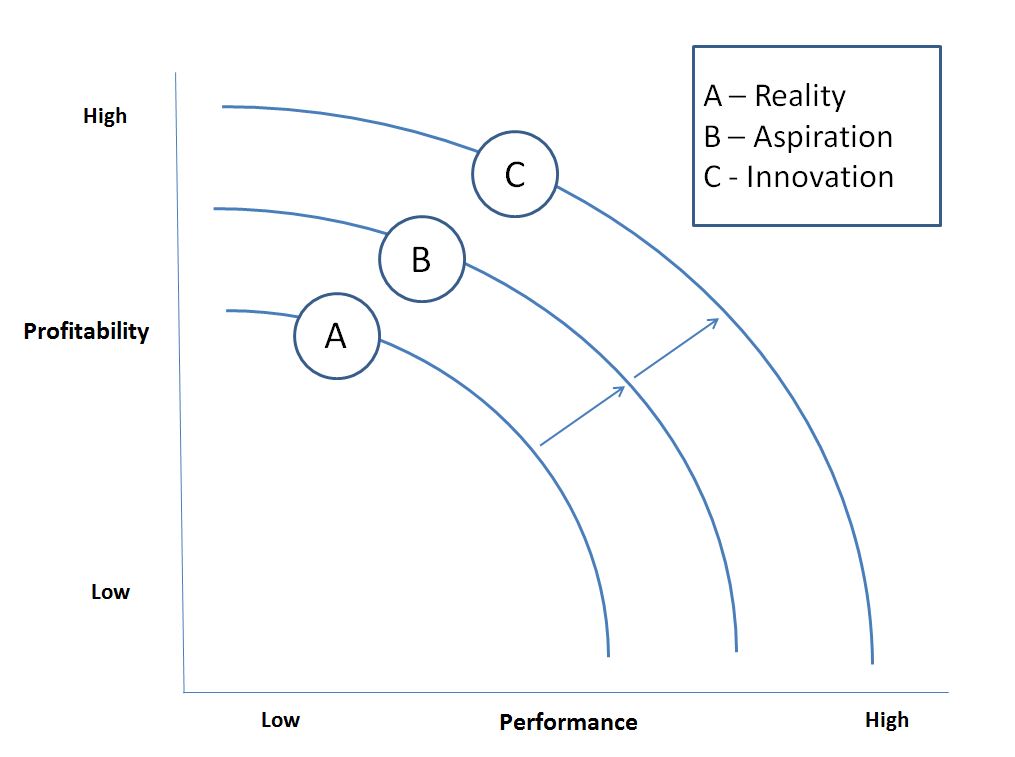
In this classic world view, achieving profitability means cutting performance, while pursuing high performance reduces profits. The relationship between the two variables can be displayed as a curve:
Population Health Blog readers can find out more about this here.
Most firms in the real world operate on the "A" curve. Different firms under different circumstances make dozens, if not hundreds, of decisions on a day-to-day basis involving trade-offs that move them along the curve that extends along the profitability and performance continuum.
Examples of healthcare companies that moved up on the curve at the expense of performance include the Veterans Administration and Turing Pharmaceuticals. At the other end of the curve, the understandable unwillingness of some hospitals to walk away from their community service obligations may have led them to bankruptcy.
The "B" curve represents the theoretical limit for greater profitability and performance using the current business model. In other words, as companies maximize all opportunities and minimize all inefficiencies in their existing business models, they can move the curve up and to the right. That is what all management, executives and boards can define and aspire to. That "B" curve is known as the "performance frontier."
Examples of healthcare companies that moved toward the "B" curve? You can find more about them here. If they're hospitals, they fill beds with short lengths of stay and high patient satisfaction. If they're clinics, they maximize billing revenue and minimize waiting lists. If they're an ACO, they manage risk by contracting for an actuarially optimum population while pursuing the Triple Aim.
The "C" curve beyond the established frontier is what becomes possible with transformational innovation, superb leadership or both. Examples outside of healthcare include Apple under Steve Jobs and Tesla under Elon Musk. Firms that create value by inspiring employees, new products and innovative processes not only benefit from even greater profitability, but offer enhanced performance.
In "C" level healthcare settings, the top-line growth and decreasing costs would be accompanied by better measures of customer/patient well-being, community burden of disease, worker engagement, leadership diversity and improvements in social determinants of health.
While the Population Health Blog eagerly awaits reports of frontier-busting healthcare providers, it offers a few observations:
1. Healthcare organizations have generally not done a good job in defining and measuring their performance metrics. They've also not made them part of the C-suite's DNA or placed them prominently on their governing boards' agendas. If they did, breakthroughs would become more likely.
2. The EHR's primary functions of billing and documentation will never get healthcare organizations to the C curve. This is not part of a breakthrough strategy.
3. In contrast, big data, risk stratification, mHealth and machine intelligence have the economic/business potential to identify risk, channel the right care, circumvent high cost service options and rationalize decision-making, but could also increase performance through the engagement of consumers, increasing access to more care options, reducing disparities and minimizing provider busywork. These are the ingredients for a breakthrough to C-curve level performance that is only just beginning.
4. By the way, another ingredient for high healthcare provider performance can be found here.
5. Last but not least, the leadership of many innovative health technology companies already intuit much of this. They're looking for partners that are not just looking for "B" level performance, but want to bust through the performance frontier.
Monday, January 4, 2016
2016 is the Breakout Year for mHealth: Savings vs. Value
 In this post, the Population Health Blog predicts how and why mHealth will be covered by more commercial health insurers in 2016, and why the retail "over the counter" mHealth market outside of insurance coverage will also continue to grow.
While you're reading, consider this simple question: What are the revolutions per minute (RPMs) of your automobile's engine as you ascend from stationary idling to freeway speed?
The Definition of mHealth: "the delivery of healthcare services via mobile communication devices." Other definitions can be found here. Elements include handhelds, wireless communications, software, hardware, networking, social media, sensor technology, apps and cloud-based services. The World Health Organization says it's global and much is still in its infancy.
Three Population Health Blog predictions for mHealth in the United States:
1) 2016 will be a breakout year, because both the savings and value propositions will be clarified.
What does the PHB mean by this?
The ultimate question for health services buyers, payers, providers and patients is whether mHealth technology is:
Substitutive: achieving savings from displacing present or future high cost services,
or
Additive: co-existing with present, or increasing future utilization.
The same is true for many pharmaceuticals, population health programs and the medical home.
2) Faced with the reemergence of unsustainable health care cost inflation, commercial health insurers will deploy today's premium to sponsor tomorrow's substitutive mHealth cost reductions.
Commercial insurers will look for mHealth that is "S3" or Smart, Synergistic and Scalable.
1. Smart: addresses the tailored needs of selected population segments; instead of being all things to all patients, think focusing mHealth on high risk patients with special needs.
2. Synergistic: enhances, not replaces other incumbent resources, such as one-on-one care management or outreach telephony.
3) Scalable: uses the economies of scale to provide a lower-cost service to larger numbers of consumers. As more patients in a select population use mHealth, the cheaper it becomes.
3) But.....Value-driven mHealth will also flourish in the direct-to-consumer, over-the-counter or retail market for three reasons:
1) Consumer notions of value:
Interest in personal wellness, a cultural belief in the pervading merits of technology and the allure of every more innovative gadgetry will continue to outpace the underlying mHealth abandonment rate.
2) As Obamacare acquaints consumers with real healthcare costs, #mHealth will be viewed as a relative bargain.
Comparatively pricey physician encounters, emergency room visits or a hospital stays - especially for Bronze Plan enrollees - will only increase consumer appreciation for mHealth's "over the counter" benefit-to-cost ratio: for a few extra bucks, why not have that weight-loss, blood-pressure, medication-management app or wearable, especially when you already have a handheld smart device and the bandwidth?
3) Some commercial insurers will "cover" wellness #mHealth, not because their actuaries support it, but because their customers (purchasers, brokers and consumers) demand it.
"Coverage" will be in the form of a volume-based discount pricing borne by the consumer, not a value-based benefit covered by the insurer. If it increases customer loyalty/"stickiness," all the better.
Plus there's the mHealth "X-Factor." mHealth sponsors and their allies will collect, sell and use consumer data for marketing and surveillance. The PHB calls it mining and monetizing.
Back to the tachometer: Even though its dashboard displays it, the PHB doesn't know the vehicle's RPMs either. Aside from the use of the tachometer by some car enthusiasts to optimize manual gear shifting, it adds little to car performance or safety.
Yet, it's standard and in the dashboard of just about every automobile being sold in the U.S.A. Could gadgets, wearables, apps and mHealth physiologic monitoring become the healthcare tachometer? Useful to a critical few and standard for everyone else?
So, What is the the Basis of the PHB's Predictions?
Growth potential:
None other than Eric Topol says "Until now, most of the effect of the digital era in the practice of medicine has been confined to electronic health records. But that is about to undergo a radical transformation in the next 5 years." As in $50 billion by 2020.
If you think it's all about "Fitbit" or managing diabetes, think again. How about promoting mindfulness, monitoring medication compliance, home-based high-risk pregnancy monitoring, in-home safety for the frail elderly, heart rhythm management, and home-based "pervasive" monitoring. Plus, mHealth style technology is being used outside of healthcare, such as in the automobile, for elite athletes and to promote safety in high-risk worksites
S3 = Savings
Smart: Here's a just-published JAMA study of a randomized clinical trial (RCT) that showed text-prompts had an clinically relevant impact on blood pressure in a group of select persons with coronary heart disease. Here's an rigorously conducted RCT that showed persons with Type 1 diabetes mellitus achieved better blood glucose control. How about socioeconomically vulnerable patients with diabetes? Or patients with heart failure being discharged from a hospital? The list of special populations with special needs goes on and on.
Synergy - This exhaustive peer-reviewed publication examining the merits of wellness mHealth for weight management, physical activity promotion, tobacco cessation, and cholesterol control shows that there's little evidence that it's better than existing therapies over the long-term. Rather, the greatest promise appears to be in complementing existing interventions. By the way, synergy does not mean overwhelming the system with data, but assisting the system with insight.
Scalable: While economists, policymakers and pundits legitimately worry whether bigger is better for healthcare in general, health system C-suites and boards of directors and their consultants are counting on information technology to drive economies of scale. Papers like this and this suggest mHealth can be a part of that, especially if it can mitigate manpower constraints.
And an easy way to assess whether the insurer really believes that it's sponsoring an S3 initiative is asking whether it pays for a handheld device for consumers that don't have one
Value:
Consumerism? Call it "the quantified patient." Here's a telling survey that shows the abiding faith in health information technology and a lack of privacy concerns.
Bargain? The title of this peer-reviewed paper says it all" "It's like having a physician in your pocket!"
Insurer discounts? The same thing happened to health club memberships.
The X-Factor: CIOs everywhere agree that they're not only apps, but software "vacuuming up data."
Thursday, March 5, 2015
The Iron Triangle of mHealth Apps Due Diligence: What CEOs and Boards Need to Know
.png)
As the Population Health Blog's medSolis CMO expertise in mHealth expands, it can't help but admire the infectious "can-do" optimism of its "app" programmer-developer colleagues and competitors. Even if healthcare is a morass of dreary economics, regulatory meddling and dysfunctional politics, these entrepreneurs really do believe that "there is an app for that!"
And neither are leaders in hospitals, clinics, provider systems, insurance companies, medical device manufacturing and population health immune from the developers' enthusiasm. "Apps" are being built or bought with the belief that they'll lower costs, create profits, increase quality, promote satisfaction, build brand, secure customer loyalty and generate invitations to White House conferences.
The PHB agrees. Apps can certainly achieve many of these outcomes, and it is looking forward to seeing the Roosevelt Room for itself in the not-too-distant future.
But that doesn't mean that CEOs, Boards and investors shouldn't be wary of how the healthcare "Iron Triangle" should factor into their "app" due diligence.
Old fashioned management experts will recognize the concept. They know that any project involves trade-offs between cost, quality and access. Improve any single dimension and the other two will suffer. Improving two means having to compromise on the third.
In other words, there are inevitable trade-offs.
Population health service providers are well acquainted with this. For example, launching a diabetes initiative means balancing the costs of the program, the intensity with which the enrollees will be managed (quality) and outreach with a span of services as well as associated risks that will be addressed (access). Accepting a lower fee per patient may lead to compromises in quality. Insisting on a greater span of managed risks could lead to higher costs or cut-backs in the level of patient counseling.
Which brings the PHB to mHealth. To the PHB, the three iron sides to configuring an app are the same:
Cost: This is not only a function of the nuts and bolts of programming, hosting and updating the app, but includes the additional economic burden of maintaining up-to-date security for the users' personal health information. There's also the added cost of updates.
Quality: This includes dimensions such as symptom control, condition management, promoting patient safety, reducing identifiable risks and measuring outcomes for quality improvement as well as research.
Access: The interface has to be speedy and intuitive, meeting consumerist expectations for ease-of use. That includes connectivity, screen loading, minimal manual inputting and efficient asynchronous communication.
How should CEOs and Boards think about apps?
They should think about cost, quality and access and understand the inevitable trade offs that underlie the sweet spot of a successful app.
Costs will never go away. But smart app developers are using off-the-shelf, open-source as well as modular programming with (secure and encrypted) web-based hosting. Shortchanging IT support or security risks not only crashes and hacking, but could limit the end-users' ability to manage the continuum of health risks (quality) in a user-friendly and speedy manner (access).
Quality is important but judgment is necessary in understanding the secret sauce that links quality, behavior change and risk. It's possible to "overdo" condition management with a glut of care options, unnecessary attention to every risk, over-engineered branching logic and over dependence on human inputs.
Access will be what the end-user cares the most about, including ease of use in a pleasing interface. Streamlining this too much, however, could lead to shortcuts that compromise optimum condition management or require additional costly information technology.
Bottom line?
If a company's senior leadership or Board of Directors is grappling with an app-based product launch, they need to understand the inevitable cost-quality-access trade-offs that were made in the course of its design. If the cost is low compared to benchmarks, ask about the compromises in quality or access that were made. If the developers claim that the condition management is the highest quality, scrutinize development costs and how access could suffer.
Accordingly, the best apps on the market will be those that strike the right balance between cost, quality and access.
Monday, February 16, 2015
mHealth Apps to Monitor Recently Discharged Patients
 |
| After knee surgery: how do you monitor this patient at home? |
While the Population Health Blog is tantalized by the prospect of healthcare consumers using mHealth apps to lower costs, increase quality and improve care, it wanted to better understand their real-world value propositions.
Are app-empowered patients less likely to use the emergency room?
Do they have a higher survival rate?
Do they have higher levels of satisfaction?
In other words, where's the beef?
That's when this paper caught the PHB's search engine eye. It's a report on using an app to monitor post-operative patients at home.
This was a "feasibility study" involving a Canadian cohort of home-based post-operative patients who had gone through either reconstructive breast or knee (anterior cruciate repair) surgery. In order to qualify, patients had to be between age 18 years and 75 years, not using tobacco and able to speak English. Once the app was activated, patient were asked about pain, their recovery and satisfaction (using a 1 to 4 scale). They also used the app to take pictures of the surgical site.
To maintain confidentiality, there were no patient identifiers linked to any images and a "locked down" subscriber identify module (SIM) was used. Data was encrypted on the server and the device.
Three surgeons participated and were responsible for reviewing their patients' data on a daily basis. The app flagged any measure that was unexpectedly out of range for expedited review.
Instruction on use of the app took between 30 and 45 minutes. Patients were loaned a smartphone or a tablet, along with an instructional booklet. At the end of the 30 day period, the smartphone or tablet had to be returned.
38 breast patients were approached at 33 agreed to participate. 40 orthopedic patients were approached and 32 agreed to participate.
Results?
The mean number of log-ins over the 30 days ranged from 19 to 24, with greater use in the first half of the month. Over 2000 photos were generated. Based on the pain and recovery scales, two early infections were identified and one was treated over the phone with antibiotics with subsequent improvement. On a 1 to 4 scale, the overall level of satisfaction was 2.7 to 3.9.
The PHB's take?
It would appear that the science on using apps to address specific outcomes in narrowly defined populations is still in its infancy. While the Triple-Aim potential of mHealth is high, we're just beginning to understand how an app would work in the real world, say.... monitoring the outpatient status of recently discharged surgery patients.
That's why this particular study was interesting. It would appear handhelds or tablets can be used in the post-operative setting, that patient satisfaction is high and that, with symptom monitoring and imaging, an early wound infection can be identified and managed early.
Naturally, it'll take a study involving a control group to better understand the true value of an app like this. Based on this feasibility study, the PHB is looking forward to reading about it in the not too distant future.
Image from Wikipedia
Tuesday, January 27, 2015
Either You Give Your Patients a mHealth App, or They'll Get One Themselves
 That's what the Population Health Blog learned after reading this research paper by Bauer and colleagues that recently appeared in the Journal of the America Board of Family Medicine.
It also confirmed that chronic care management apps are a business opportunity.
What was the research and what did it show?
All adult patients receiving care at six clinics in a northwest U.S. primary care network during a two week window of time (June 2013) were anonymously surveyed about their use of mHealth.
Depending on the clinic, 22% to 62% of the patients were insured by Medicaid. More demographic info can be found here.
1363 surveys were distributed and 918 (67%) were completed.
91% had a mobile phone and more than half (55%) owned a smart phone.
Among the smart phone owners, 70% had used "mHealth." 57% had downloaded at least one app. Of these, 69% used it less than 3 times a month, while 11% used it on a daily basis.
There was no association of mHealth participation with health literacy, chronic conditions or depression. Use was more prevalent among persons less than age 45.
One third used "general" health apps, while one quarter used fitness, diet or weight-loss apps. Only 3% used it for chronic disease management.
The authors asked respondents to use a 1-5 scale to rate the desirability of various app features. Appointment reminders came in first, followed by medication reminders and general health information.
10% learned about this from their physicians and only 31% "prioritized" their physician's involvement.
The PHB's summary:
Smart phone and app use may be more prevalent in the northwest, which may make the findings of this survey less generalizable to the rest of the United States. With that caveat, approximately 40% of the patients sitting in the average primary care clinic waiting room are mHealth users and about 20% are using health apps. And what do patients most prize in their apps? Reminders about appointments and medications.
What's more, most of this is occurring without the benefit of their providers' participation.
Last but not least, apps have not penetrated the chronic disease population.
The PHB's take?
1) If all those patients with smart phones are going to download apps, they might as well download ones that - at a minimum - are endorsed by their providers. Optimally, they should complement their providers' services. Used right, they might be able meet their patient's desires for coordinated appointments and increased medication compliance.
Providers and patients would benefit from better quality and lower costs.
2) And patients with chronic conditions have yet to discover apps. That may be a function of age, but it may also be a function of the conspicuous silence of their providers as well as the failure of the currently available apps to meet their potential customers' desires.
That spells opportunity. Recall the adage of the two shoe salespersons who were sent to Africa. The more pessimistic of the two found that none of the natives were using shoes and decided to return home. The optimist likewise found that no one was using shoes, but he called back to the home office and asked for help.
The market for chronic care apps needs help.
Image from Wikipedia
Thursday, January 22, 2015
Could mHealth Apps Be a Reprise of the EHR? The Need for Clinician Input
 While the Population Health Blog continues to delight in the emerging science of "mHealth" as a newly minted start-up Chief Medical Officer, it ran across this interesting article on risk and patient safety.
 Authors Thomas Lewis and Jeremy Wyatt worry that "apps" can lead to patient harm.
They posit that the likelihood of harm is mainly a function of 1) the nature of the mistake itself (miscalculating a body mass index is far less problematic than miscalculating a drug dose) and 2) its severity (overdosing on a cupcake versus a narcotic). When you include other "inherent and external variables," including the display, the user interface, network issues, information storage, informational complexity and the number of patients using it, the risks can grow from a simple case of developer embarrassment to catastrophic patient loss of life.
In response, they propose that app developers think about this "two dimensional app space" that relies on a risk assessment coupled to a staggered regulation model. That regulation can range from simple clinical self assessment to a more complex and formal approval process.
What's clear to the PHB is that hidebound mainframe entities like the Food and Drug Administration are no match for the app "ecosystem". Rather than try to formulate a one-size-fits-all "not function as intended" model like this, maybe it should triage its oversight using the Lewis and Wyatt framework.
In addition, the PHB agrees with Lewis and Wyatt that safety is also a function of clinician input. Docs and nurses can assess possible mistakes, their downside severity and the impact of all those variables.
The PHB couldn't have put it better:
".... many app developers have little or no formal medical training and do not involve clinicians in the development process and may therefore be unaware of patient safety issues raised by inappropriate app content or functioning."
Without the insights of seasoned real-world doctors and nurses, apps could end up with the same safety issues that are plaguing electronic health records, many of which were also developed with little regard to physician or nurse input.
In other words, just because it's a "health" app doesn't mean its necessarily so.
Image from Wikipedia
Monday, March 24, 2014
Ten Things to Know About the mHealth App Ecosystem.
 |
| A mHealth app walled garden: enter at your own risk? |
Naturally, for time-pressed readers who'd rather not read it all, your PHB is happy to provide this ten point summary.
1) There are more than 40,000 of mHealth apps and the industry is still in its infancy.
2) Despite their faddish sexiness, there is very little hard evidence that many of the commercially available apps to lead to measurable improvements in clinical or economic outcomes. However, some of the underlying technology (such as pedometers) does provide a benefit.
3) The Food and Drug Administration (FDA) will assert its regulatory authority if the app "acts" like a "medical device" or as an accessory to a "medical device." Logging data, retrieving content or communicating won't be regulated, but medication dosing guides or the provision of diagnostic information will be.
4) 3) Little is known about the physician prescribing patterns for apps. We also haven't figured out if or how a patient's access to an app should depend on a licensed professional's approval/prescription.
5) There is a possibility that many currently available apps are putting users' privacy at risk.
6) Little is known about apps' compatibility with electronic health records (EHRs). This may be less of an "ecosystem" and more a bunch of isolated "walled gardens."
7) One vulnerability to any app's usefulness is data overload. Hundreds of food entries, for example, may do little to increase user insight about his or her diet.
8) Other than the FDA and its fussing over apps' medical "deviceness", there is no agency or entity that provides certification for apps. Consumers are on their own, based largely on on-line reviews and word of mouth. One organization tried to do it and conspicuously failed.
9) The time is right to create "guidelines" for app developers, such as how to provide useful data summaries as well as visual displays, maximize patient safety, ensure information accuracy and protect consumer privacy.
10) The time is also right for funding agencies to support research on apps, especially for persons with chronic illness.
Naturally, the PHB offers commentary:
It remains to be seen if the FDA can keep up, especially with apps that are in the "grey zone" between offering advice/possibilities vs. diagnosis/treatment. That shortcoming is vulnerable to overlawyering and regulatory overreach. That means prolonged time to market, increased uncertainty, hampered innovation and the threat of retroactive and potentially capricious reviews.
As you are reading this, many apps are undoubtedly being developed by the population health service providers. It may be time for entities like the Population Health Alliance or stakeholder organized medicine organizations to take the lead in establishing app benchmarks, best practices and guidelines. If they don't lead on this, someone will do it to them.
While vendors that offer apps along with their coaching may be inclined to regard them as proprietary and shield them from the scrutiny of peer review research, apps that are proven to improve outcomes will ultimately rise to the top. It's not just the funding agencies but the companies that offer these apps that have a stake in "proving it," while also advancing medical knowledge for the betterment of all of us.
Finally, wouldn't it be neat if there was a generic mHealth app that could be used by medical homes to facilitate nurse-patient coaching, link the patient to the EHR and enhance communication with providers? If there is one that the PHB isn't aware of, it wants to know about it.
Image from Wikipedia
Wednesday, October 30, 2013
More on Health Apps: Opportunities, Risks and the Implications for Population Health Management
 It's called "mHealth" but others may call it "health apps." The FDA calls it a target rich regulatory opportunity. Others may call it hype.
The Disease Management Care Blog calls it inevitable.
Writing in JAMA, Drs. Steinhubl, Muse and Topol of Scripps agree and say that the future is bright for mHealth. Its adoption is being driven by the threefold convergence of:
1) the search for solutions that address otherwise unaffordable levels of healthcare spending,
2) the availability of broadband wireless connectivity, and
3) consumer demand for individualized care.
The DMCB suspects any one of the DMCB's 5000 regular readers could have written this article. Like Steinhubl et al, they already know that patients want self-diagnosis and condition monitoring. Health consumers want greater efficiencies and enhanced patient-physician collaboration.
Even tech-skeptics have to admit that it's possible that mHealth could lead to a utilization trifecta of fewer office visits, avoided emergency room visits and decreased hospitalizations. Imagine the handheld that can accurately catalog signs and symptoms that help the user discern between a simple self-limited cold vs. a more serious case of pneumonia, or benign skipped heart beats vs. a more worrisome arrythmia.
Handheld apps for chronic conditions are more available than realized. They are on the cusp of going mainstream with assisting hypertensives, diabetics and asthmatics monitor and act on their blood pressure, insulin dosing and inhalants.
If they work right, providers could review summary data and offer guidance via emails and texts in lieu of adding a patient on to the schedule at 5 PM. If done right, the background algorithms could liberate physicians to pay greater attention to the important stuff that requires their complex cognitive or procedural skills.
The authors point out that that doesn't mean it's going to be easy. Medicine is complex and getting paid for it is more so. There's also worry - warranted or not - about the decline of face-to-face doctor-patient relationship. mHealth can lead to overwhelming data gluts characterized by a lot of numbers with little actionable insight. Finally, there's the danger that an app can offer ineffective, inaccurate or dangerous guidance that leads to patient harm.
Bravo to the editors of JAMA for recognizing the importance of the topic and committing precious space to this manuscript.
That being said, however, this article fails to give a full accounting of all the opportunities as well as risks for "mHealth."
First off, as this Kaiser Health News article demonstrates, there are two additional opportunity dimensions that draw on the population health management business model:
1) Apps are not just for diagnosis and monitoring, but also for wellness, and
2) They're being principally sponsored by commercial health insurers who not only readily embrace innovation, but probably consider apps a "sticky" way to maintain customer loyalty. That is doubly true for engaged enrollees who ultimately represent a better insurance risk. In fact, the DMCB suspects that value proposition is so compelling that insurers are willing to use apps as a "loss leader."
Oh, and while mHealth can be built, it's far more likely it's being bought. As in population health management vendors.
Risks? You bet.....
1) The fit of mHealth with the electronic health record (EHR) remains an open question. The DMCB is no coding geek, but it's safe to say that it's not automatic that two independently contrived technologies can automatically "speak" to each other or that the data from an app can by downloaded, summarized and coherently presented to a user at the point of care.
2) As noted in this article on telemonitoring, it's also not necessarily true that mHealth can be equated with stand-alone technology. Depending on the condition and the need, mHealth will have to be often tethered to human support services.
3) As even casual observers are aware, allegations of "malpractice" are not unusual in health care. Rather than comment on its friends who make a living off of contingency fees, the DMCB will only point out that mHealth may offer a target-rich rich environment for personal injury attorneys intent on using the legal theory of joint and several liability to maximum effect. That threat may slow adoption of mHealth.
Image from Wikipedia
Subscribe to:
Posts (Atom)



 Posts
Posts