Showing posts with label MedPAC. Show all posts

Tuesday, March 11, 2014

Smart MedPAC Wonks Think Out Loud About the Medical Home

If you spend a lot of time building, administering, expanding, marketing, promoting or networking "medical homes," it might be a good idea for you to read this MedPAC meeting transcript.

As Population Health Blog readers know, the Medicare Payment Advisory Commission advises Congress on how to best run Medicare, which includes the thorny issue of how to pay physicians who care for Medicare beneficiaries. During their March 6 meeting, the Commissioners discussed how to replace the primary care bonus program that is set to expire at the end of 2015.

By the way: The 10% bonus in 2012 amounted to $664 million for approximately 200,000 providers caring for 21 million beneficiaries.  That means, thanks to Uncle Sam, average participating docs got another $3400 in yearly income.  For PHB readers who are familiar with the per-member-per-month metric, that amounts to $2.60 PMPM.  As of 2014, there is still no hard information on whether the bonus resulted in any improvement in access, quality or outcomes.  In fact, despite the bonus, there is preliminary data that 28% of Medicare beneficiaries have had trouble finding a primary care provider.

As the PHB understands it, the bonus program was funded with additional fee-for-service money for primary care services.  Since that's going away at the end of next year, the Commission considered whether to continue it as is, or to reengineer it as a medical home payment system.

The transcript on whether to pay for medical homes reflects a wandering discussion with no final consensus. That being said, there were some interesting takeaways from a group of policy wonks who've spent a lot of time thinking about this approach to care:

Budget Neutral Bad News: While you may argue that the medical home "saves money" in excess of the fees used to pay for it, no one at MedPAC believes the additional funding will continue.  That means the $664 million after 2015 will likely have to come from budget-neutral reductions in payments for other medical services.  In zero-sum terms, that means someone (specialists?) has to lose in order for the medical home to win.

Definition: While there was admiration for the National Committee on Quality Assurance recognition program for medical homes, Commission members wondered whether that recognition translates into value. Would a "leaner" model be more cost effective?  And, if Medicare favored a non-NCQA leaner medical home structure, how would it be implemented?  It providers had to apply for it, should they subject to an audit?

Attribution: Figuring out which doc among several should be paid for medical home services isn't easy.  There was little appetite for having beneficiaries sign an attestation, while a claims analysis would have to be done using a "look-back" based on Medicare billing patterns.  That would result in a one year payment delay.

Whither Primary Care: There was doubt that an additional income stream of $2.60 PMPM would be enough to incent medical students to shun higher paying specialty careers.

Generalizability: There was some doubt on whether the medical home works outside of integrated delivery settings. 

More Bad News On The Way?: One Commissioner also works as an editor at a top tier medical journal, and he hinted that more negative manuscripts on the medical home are being submitted for publication.

What Wasn't Said: The Population Health Blog was surprised that MedPAC did not address:

1) the concept that the medical home should be directed at a subpopulation of patients most likely to benefit (raised in this "one size does not fit all" editorial), or

2) that getting the Medicare bureaucracy to introduce a new complex payment mechanism may be far more easier said than done (and that's according to White House insider Dr. Emanuel)


Tuesday, August 27, 2013

Fee-for-Service Medicare Beneficiary Access to Care: The Truth May Be More Complicated

According to this just-released Health and Human Services Issue Brief, the percent of U.S. physicians "accepting new Medicare patients" increased from 87.9% in 2005 to 90.7% in 2012. What's more, this rate of uptake of new Medicare beneficiaries is tracking higher than the rate of "new privately insured patients."

The Issue also says there "may" have been a "very small increase" in the number of docs who have dropped out of the Medicare program. Those drop-outs appear to be greatest among psychiatrists (1.1%) and plastic surgeons (1.6%). In contrast, only 0.35% of primary care physicians have dropped out. These drop-outs have been more than compensated for by the new physicians entering the labor market.

Except for 2012, these data are from the in person interviews that comprise the National Ambulatory Medical Care Survey, The 2012 numbers are described as "interim," because they are based on a mail-in survey.

The Issue brief also quotes a separate MedPAC annual survey of thousands of Medicare beneficiaries. According to the brief, 77% reported they never experienced a delay in getting an appointment for routine care, compared with 76% in 2008.

Case closed, right?  The Disease Management Care Blog's dire warnings about a widespread provider exit from Medicare that was echoed years later by the Wall Street Journal have been overblown.

Not exactly, speculates the DMCB, for the following reasons:

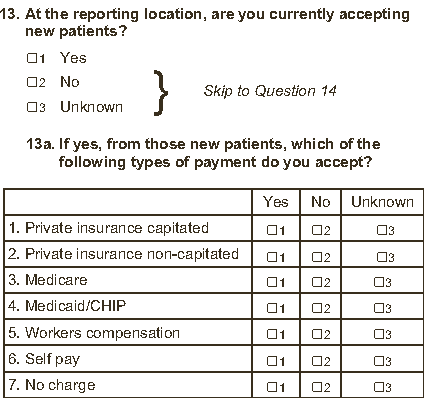
1. The DMCB pulled a copy of the NAMCS survey and found the question that was apparently used to assess physician participation. The screen shot is above. It generically refers to "Medicare," not fee-for-service Medicare.  Because many physicians are members of insurance networks, an affirmative answer could be misinterpreted by the respondents as referring to Medicare Advantage. 

2. There is a difference between "accepting" new patients vs. welcoming new patients. In this seminal New England Journal study, many respondents "accepted" "new" Medicaid beneficiaries, but moved them to the back of the appointment queue.

That being said, the MedPAC survey suggests that isn't happening           - yet - to Medicare beneficiaries. And that's assuming a health care consumer's definition of "delay" hasn't been dumbed down since 2005.   

3. Last but not least, the NAMCS numbers represent a national average. Many areas of the country have seen consolidation of physician practices into larger groups. The DMCB suspects these entities are more willing to accommodate Medicare beneficiaries. It's very possible that the smaller physician-owned practices - many of whom practice in rural areas - are less likely to do so in 2013 than they were in 2008.

Coda:

In yesterday's post, the DMCB was introduced to "twerking." After additional inquiries of the DMCB spawn, it has learned more about this curious phenomenon. 

Which led to this insight:

Q: What is one key similarity between twerking and being an ACO?

A: You better be careful doing both, otherwise you could get screwed.


.

Tuesday, July 1, 2008

The Innovator's Dilemma, Bundled Payments and the Prognosis for Disease Management

Many years ago, the Disease Management Care Blog was involved in a doltish exercise in planning how to prepare specialist physicians for careers in primary care. As part of this work, we faux experts predicted an oversupply of physicians in light of the rationalizing of medical services thanks to ascendant managed care. Boy, in those heady pre-backlash days did we ever get it wrong.

However, one trend became apparent to the DMCB at that time and it still holds true: the increasing ‘upward competency’ of health care providers. We assumed, thanks to technology and market demand that the expertise and skills required of specialists could be acquired by non-specialist physicians and that primary care physician expertise and skills could in turn be acquired by non-physicians. Think of it as a medical form of the ‘innovator’s dilemma.’

We are seeing versions of this trend today. For example, invasive cardiac surgery performed by intensely trained cardiac surgeons has been supplanted by stents from cardiologists, while highly accurate coronary artery imaging that could only be obtained via a cardiologist-performed catheterization can now be obtained directly by primary care physicians in the form of multi-slice CAT scanners. In the meantime, many of the traditional diagnosis and treatment roles of primary care physicians have been taken up by professional non-physicians, while at the end of the line, we’re finding that patients can assume many of the day to day duties of education and management. Patients aren’t ready yet to remove their own appendices, but the trend in many areas of health care – including chronic conditions – is definitely there.

Unfortunately, the ‘defined benefit’ of typical fee-for-service (FFS) insurance has trouble keeping up with these shifts in physician competencies. That’s because the coverage of any given service typically hinges not only on the nature of the intervention itself but on the entity or physician performing the service. Approval of the physician is often contingent on their credentials, which are reviewed by the ‘credentialling’ process of health insurers. Not credentialed to bill for a service = not covered.

What can change this pokey nature of FFS style health insurance? The DMCB likes an editorial from our friends at MedPAC in the July 3 2008 New England Journal of Medicine (and it's not online at the time of this posting). Hackbarth and colleagues describe the MedPAC recommendations about the use of bundled inpatient payments by Medicare. They argue that global payments that include the hospitalization itself as well as all the physician services and several weeks of post-discharge care will lead to better coordination or services, higher quality and lower costs. This is a limited version of Porter and Teisberg's recommendations for payment for 'episodes of care.'

The DMCB thinks this is a good idea. If the global payment approach fulfills its promises and physicians do not end up being disenfranchised (think backlash Ver 2.0), similar payment approaches for the outpatient management of chronic illness may eventually follow. Simplistically thinking, if there is a similarly contrived reimbursement for the ongoing care of chronic conditions, it would be up to the specialists, primary care providers, non-physicians and even the patient to sort out who does what with the resources at hand. Services within the care episodes would move to the appropriate level of care without having FFS process and financial disincentives get in the way. Given its efficiencies and effectiveness, the DMCB is confident versions of disease management would be sought out as one component of a coordinated delivery system (a.k.a. Dr. Casalino’s ‘accountable care organization’) for chronic illness, leading to the emergence of partnerships between physician-organizations and vendors. The upward competency/innovator’s dilemma wouldn’t need to wait for fee schedule updates from health insurers.

The DMCB agrees this sounds naively utopian but there’s something to this. Cheers, MedPAC.

Friday, March 7, 2008

MedPAC, Primary Care: Twidling the Dials.


MedPAC has just released recommendations to Congress about physician payment.


The Disease Management Care Blog finds it interesting that the Commission's report:

1) uses Medicare beneficiary access to care as the fundamental gold standard of payment adequacy. Other peer reviewed evidence as well as physician grexing are important, but much less so. Basically, if Medicare beneficiaries, according to the MedPAC surveys, get the care they need, what’s the problem?

2) focuses on the a) physicians and b) their payment as the primary engine that drives the content of care. That stands in depressing contrast to all those other broader highfalutin strategy proposals to foster novel systems of care.

As a service to its readers, the DMCB humbly offers up this capsule summary on the primary care dimensions of this MedPAC tome:

Access, according to the beneficiary surveys, has clear sailing but there are storm clouds ahead. While not a statistically significant finding, 30% of the ‘10% of the beneficiaries who looked for a new primary care physician’ reported there was a problem finding one, vs. 24% from the year before. As a result, MedPAC suggests that future payment adjustments may lead to further primary care access problems. The report then has vague references to the options of ‘rewarding' and 'providing incentives' to physicians to provide higher quality care and care coordination, as well as exploring 'design issues' to implement a 'medical home.'

Hmmmm. While Medicare is tied up in a lot of statutory and regulatory language, I think MedPAC could have should shown a little bit more gumption. While I agree with the 'access' gold standard, other corners of the Medicare apparatus seem to be a little bit more inclined toward using its purchasing power to drive real healthcare change. Twiddling the twin dials of a) physician and b) payment may taste safe in the primary care arena but it’s less filling.

[Sigh] C’mon MedPAC.
According to the “About” portion of the MedPAC web page, your job is to advise Congress about “issues” not “payments.” Quality access to the full spectrum of care is an issue that deals more with patients with less focus on physicians and payments. Everyone already knows that primary care physicians need to be paid far more for their evaluation and management services, but that ingredient is only necessary, not sufficient. The disease management community knows this and even the latest New England Journal of Medicine points to some other exciting approaches.

And by the way, good luck in trying to figure out just who to pay when it comes to care-coordinating primary care.