While there many maxims about the delivery of healthcare, the MedSolis Chief Medical Officer PHB has discovered that three in particular stand out:
Showing posts with label Heart Failure. Show all posts
Monday, November 21, 2016
Countering the Cruel Tutelage of Healthcare Access, Quality and Cost: How mHealth Can Do It Faster, Better and Cheaper
While there many maxims about the delivery of healthcare, the MedSolis Chief Medical Officer PHB has discovered that three in particular stand out:
1) Many healthcare outcomes are more a function of social, economic and cultural determinants than medical quality. Zip code trumps diagnosis code.
2) Say's Law warns us that healthcare utilization may be a function of sevice availability rather than need. As a result, compelling innovations like this or this can be "additive" to healthcare, not "substitutive." Demand trumps discovery.
3) Healthcare access, quality and cost are interdependent, and improvements in one has downsides in the other two. For example, price controls can lead to lower access in the form of queues. Increasing quality can drive up prices. And, Obama's healthcare reform emphasizing better access arguably led to higher prices.
Trump's rhetoric trumps brainy Obamacare.
Naturally, there are exceptions to every rule. And the PHB wonders if healthcare technology's mHealth may offer an important exception to rule number three.
If so, there are important implications for U.S. healthcare delivery.
An important mHealth mantra for MedSolis is "faster, better, cheaper." mHealth is defined as as any medical practice supported by devices such as mobile phones, patient monitoring devices, personal digital assistants (PDAs) and other wireless technology. A considerable body of literature on the topic shows that patients using mHealth can access the information they need to make informed choices, that those informed choices serve greater engagement, and that this leads to fewer avoidable complications.
Examples from the MedSolis #mHealth archives:
Mary Jones* has diabetes, and uses her smart phone paired bluetooth-enabled blood sugar monitor to assess her diabetes control versus diet, exercise levels and medications. Her A1c improves, which correlates with her future health care costs. She not only sees her outpatient physicians less often, but the A1c data inform public measures of quality and decreases the likelihood of depression. Ms. Jones has hit the trifecta: lower cost, higher quality and better access to more care.
William Smith* has heart failure and has just been discharged from a hospital. He uses a telemonitoring-linked home scale to detect the subtle increases in weight from fluid retention that can herald an exacerbation of his condution. William knows how to increase the dose of some of his medicines leading to return of his weight to normal. William has avoided an unnecessary night in the emergency room. What's more, the avoided readmission is an important measure of quality. Mr. Smith has also hit the trifecta of lower cost, higher quality and better access to more care.
Bottom line: as healthcare consumes a greater fraction of the U.S. gross domestic product, the cruel tutelage** of healthcare acess-cost-quality can be mitigated by faster-better-cheaper. Whether it's Obamacare, Repeal, Replace or Trumpcare, the the value proposition of mHealth will endure.
*Names and scenarios are realistic, but ultimately fictional
** With apologies to Pai Mei and his fans
Labels:
Heart Failure,
Iron Triangle,
medSolis,
mHealth. Diabetes,
Say's Law
Monday, June 16, 2014
The Evidence Supporting Heart Failure Care Management
![]() |
| "Yawn!" |
They all involved some version of risk stratification and a combination of telephonic and in-person nurse-based care management.
And they all worked.
Which is why the Annals of Internal Medicine could have saved itself a lot of time and effort by simply asking the PHB for a summary. Instead, it did the next best thing and published this meta-analysis by Feltner et al. The authors pooled the data from 47 randomized clinical trials and found that both in-person and telephonic nurse-led disease care management reduced readmissions to a statistically significant degree.
Takeaways:
1. This is another example of old news not making reaching the elite ruling classes of Academikstan until well after the fact.
2. For my colleagues in the medical home movement, take note: achieving financially relevant outcomes will depend on focusing care management where it will have greatest impact. Instead of managing all patients with heart failure (for example), start by managing the patients at risk of (re) hospitalization. That's where the return-on-investment gold can be mined.
Image from Wikipedia
Monday, July 8, 2013
Population Health Management to Screen and Treat Patients with Elevated BNP at Risk for Heart Failure
![]() |
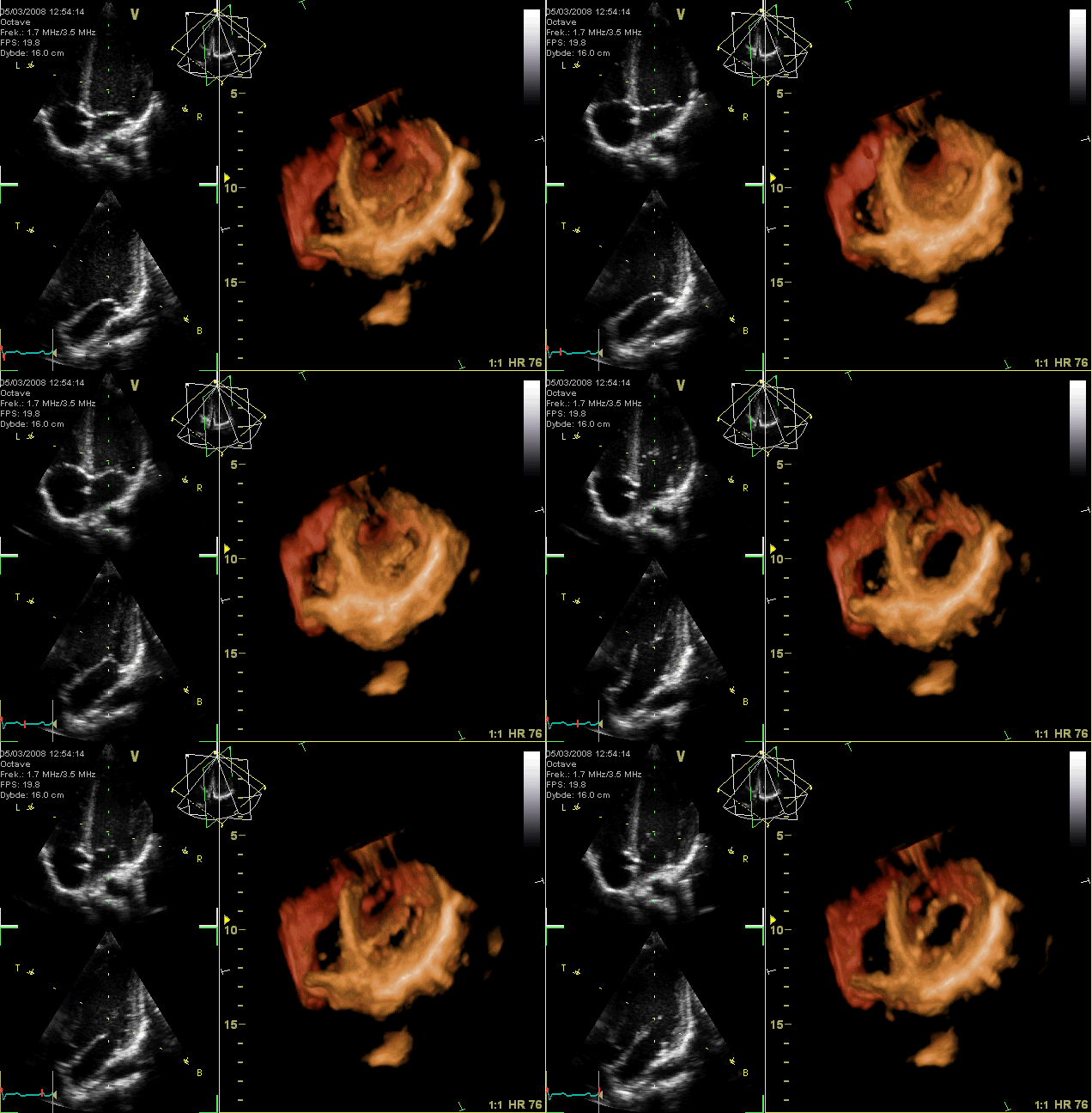
| An echocardiogram of the heart |
After years of being treated for persistent asthma, Dr. Smith (name changed) found his usual mix of inhalers and pills was no longer working. Unable to comfortably sleep at night and finding he couldn't hustle as quickly up and down his clinic's hallways, he decided it was time to see the Disease Management Care Blog. After a quick look and a listen to his heart and lungs, the DMCB tapped its heuristics and made a shortcut bet that this wasn't asthma. The echocardiogram that was obtained that afternoon proved that it was right: Dr. Smith had heart failure.
Heart failure is the leading cause of hospitalizations in the elderly and is a huge cost to the U.S. health care system. Therefore, if docs like the DMCB on an individual basis - or the U.S. on a health care policy basis - could prevent heart failure, that would be a big deal.
"Natriuretic Peptide–Based Screening and Collaborative Care for Heart Failure - The STOP-HF Randomized Trial" that was just reported in JAMA may be a step in that direction.
The DMCB explains.
First off, there is a hormone that is made by a stressed heart (yes, the human heart secretes hormones) called "naturetic peptide" (or NP) that signals the kidneys to excrete more salt and water. "BNP" is one type of naturetic peptide that can be detected using a simple blood test.
The STOP-HF trial set out to examine whether BNP levels could identify otherwise well-appearing persons with stressed hearts who were at future risk for the development of clinically evident heart failure. By catching these persons early and getting them into treatment, the hope was that these patients wouldn't turn out like Dr. Smith.
39 practices in the catchment area of Dublin Ireland's St Vincent's Hospital referred patients who were older than 40 years and had one of the following cardiovascular risk factors: high blood pressure, high cholesterol, an obese body mass index, documented (by an angiogram or a known heart attack) coronary artery disease, history of stroke, peripheral vascular disease, diabetes, arrythmia or heart valve disease. Persons with known heart failure were excluded from the study.
After entry into the study, patients had a BNP level drawn and were then referred to either a "control" (observation only) group or to an intervention group.
In the intervention group, patients with an elevated BNP level of 50 pg/ml or more were referred to a cardiology service and had a cardiac function study using echocardiography. In addition, any of the cardiovascular risk factors were aggressively managed with medications and a specialist nurse-coach.
In the control group, physicians and patient were not told about the BNP level and were cared for on a routine basis. Patients were not referred for any cardiology care unless another reason supervened.
1374 patients were randomized, 697 in the intervention groups and 677 in the control group. High blood pressure was the most prevalent risk factor and most patients had two risk factors. 263 (38%) and 235 (35%), in the two groups respectively, had BNP levels greater than 50 pg/ml. Average follow-up was 4.2 years and all patients eventually had an echocardiogram to assess their heart function
During follow-up, 8.9% of the control group patients and 5.3% of the intervention patients developed heart failure as determined by echocardiography. That difference was statistically significant and was due to a higher level of treatment with drugs that help control risk factors and prevent heart failure. When the DMCB uses a number needed to treat analysis, the works out to 28 patients needing to be screened and treated for an elevated BNP to avoid one case of heart failure. That's not bad, even if you compare it to aspirin and heart attacks. There were also fewer emergency room visits and hospitalizations in the intervention group.
The DMCB's take:
1. This is classic population health management: This study was not only about using BNP to find patients at risk for heart failure, it was about relying on nurse coaches to manage the underlying clinical drivers, such as high blood pressure or underlying coronary artery disease. If the DMCB suggests a better title for this article would have been "Population Health Management to Screen and Treat Patients with Elevated BNP at Risk for Heart Failure."
2. An appealing value proposition with a return on investment: Given a NNT of 28 and the future costs of heart failure, combined with statistically significant reductions in emergency room use and hospitalizations, the DMCB expects population health management service providers as well as medical homes to use BNP and non-physicians to screen and treat patients to prevent heart failure.
3. Still imperfect: Despite aggressive management by a specialized team, 5% of patients in the intervention groups went on to develop disease. We have a ways to go.
Image from Wikipedia
Labels:
BNP,
Chronic Heart Failure,
Heart Failure,
JAMA,
Naturetic Peptide
Subscribe to:
Posts (Atom)